
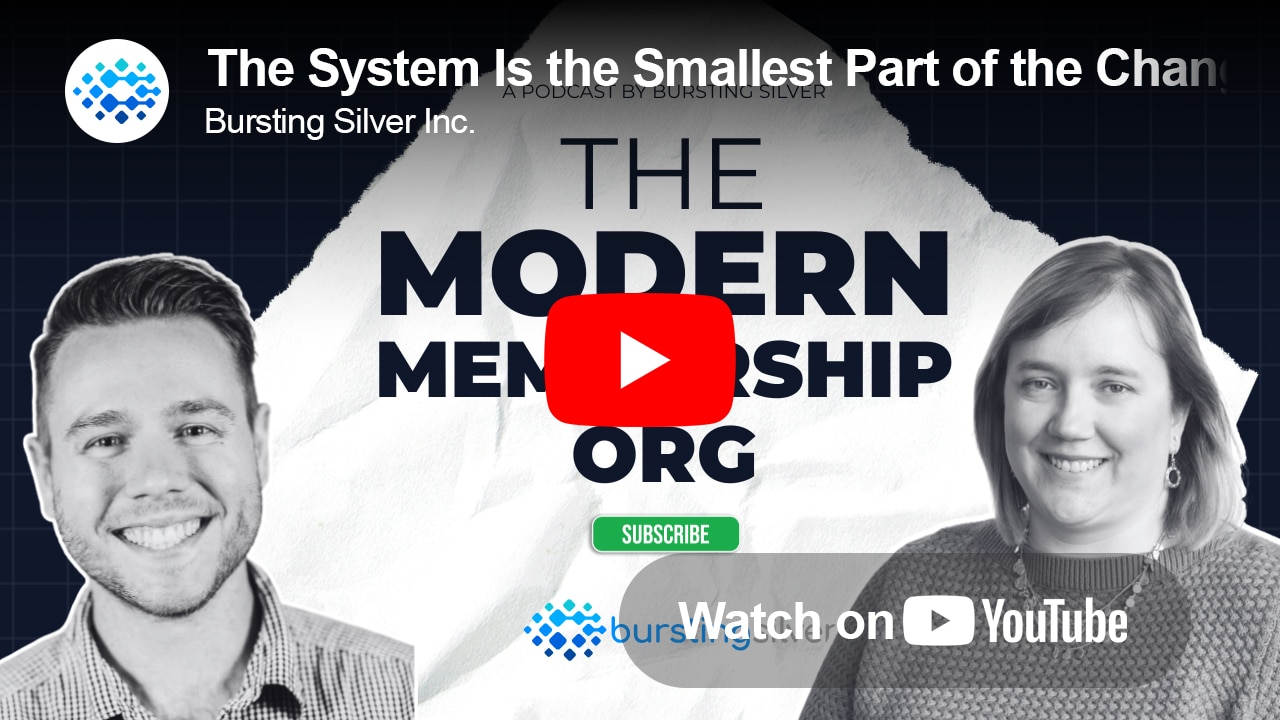
Episode summary
Ellen Turner has sat on both sides of a system change. Years before she became a senior consultant at Bursting Silver, she was association staff when leadership announced a new system with zero warning. Her whole team had the same reaction: wait, what? On her second visit to The Modern Membership Org, she and Riley Miller make the case that the software you’re moving to is usually the smallest part of the change. What actually moves is everything underneath it.
Ellen compares switching systems to buying a new car. You still know how to drive, but where’s the light switch, and which stalk runs the rear wiper? Muscle memory keeps going to the old place, and the same thing happens to staff in a new system.
The conversation gets practical from there. Teams that rebuild their old system inside the new one, workarounds and all. Data cleanup with no magic wand. And Ellen’s budget advice after five-plus years of implementations: when money is tight, trim the scope of the go-live, never the training. Every cut training budget she’s seen got re-spent on support tickets within a month or two.
Her starting point for any leader a year out from a change: get a representative sample of staff into the discovery sessions. Somebody in membership can’t speak for what finance needs.
In this episode
- What actually moves when you switch systems: data structure, saved reports, and the internal navigation your staff run on every day, and why it amounts to “a brand new way of everybody doing their day-to-day.”
- Ellen’s car analogy: same functionality, new muscle memory. Why even an upgrade means retraining your brain, and why that’s a training problem, not a talent problem.
- The rebuild trap: teams that recreate their old system, including its limitations and workarounds, and miss the new features that would make members’ and staff’s lives easier.
- No magic wand for data: bots flooding open account-creation forms, change-of-address files overwriting newer data, and why some hygiene checks are monthly, some weekly, and some daily.
- The budget conversation: why you should minimize the scope of the implementation before you ever touch the training budget, and phase the nice-to-haves into a later release.
- Ellen’s Monday-morning to-do for leaders: put a representative sample of staff in the discovery room, let them carry pain points back and forth, and never make the decision in a vacuum.
Hosts & Guests
Riley Miller – Host
Sales and client success lead at Bursting Silver, helping membership organizations modernize iMIS, data, and AI workflows across North America.
Ellen Turner – Guest
Senior consultant at Bursting Silver, where she’s spent a little over five years walking organizations through upgrades and new implementations. Before consulting, Ellen worked inside a not-for-profit trade association — where she learned iMIS and lived through a system change from the staff seat — and spent over a decade in the education sector, including three years in database management. She holds a deep stack of iMIS Learning Hub certifications (CiA, CiP, CiSE, CTCA, COWA) plus the CAPM, and is a longtime member and presenter in the iMIS Users Group. Reach her at [email protected] or on LinkedIn.
About Bursting Silver
Bursting Silver is a fully remote consultancy specializing in modern CRM, iMIS, and AI solutions for membership organizations across North America. We’re a 3-time Great Place to Work Certified company that helps associations, unions, and regulatory bodies modernize legacy systems, improve data quality, and deliver better experiences for staff, members, and registrants.
Our unique ability is finding the simplicity in the complex.






The Modern Membership Org Podcast
Full Transcript
Ellen Turner (00:00) You need to make sure that you let employees feel like their voices are being heard, and let those representatives go back to their departments and ask: what are your pain points in the software? What would you really like to see in the new software, and what should be avoided? So that you as a leader don’t have to make a decision in a vacuum and just say, “Hope you guys like it. Hope it suits every department’s needs, because this is what I’m going with.” You’re already going to have that information, and you can hopefully then make the informed decision that’s going to be the best opportunity for all the departments to succeed.
Riley Miller (00:41) All right, welcome back to another episode of The Modern Membership Org Podcast. My name is Riley, here with Bursting Silver, and I am joined today by a return guest, Ellen Turner. Welcome back to the show.
Ellen Turner (00:53) Glad to be here.
Riley Miller (00:55) Happy to have you on too. I think last time we talked about the iMIS community, and today you reached out actually because you had a topic that you really wanted to dive into. It’s something that we’ve already explored on the podcast here, but something that you’re pretty passionate about as well: the change management process from moving systems is pretty disruptive, obviously, but it’s not always the software that is the biggest part of that change. So I might hand it over to you to — once again, for those listening for the first time — introduce yourself and give a little background on yourself.
Ellen Turner (01:28) Absolutely. So I’ve been at Bursting Silver for a little over five years now. Prior to joining Bursting Silver as a consultant, I was working at a trade association, and that was my introduction to iMIS. And before that, I worked in a couple of other databases across a number of different types of organizations. So I’m just really familiar with database management and the ups and downs, pros and cons that go along with it.
Riley Miller (01:58) As part of our episode that we explored last time too — and people are welcome to listen as well, about the iUG community — it’s what it means to sit on both sides of the aisle here. You’ve been on the inside of an organization that’s gone through a big change, and now you’re a consultant that is walking other people through it. So maybe from the seat of being on the receiving end of that big change, internal at an organization: what caught you off guard the most during that process for you and your team?
Ellen Turner (02:25) I think one of the biggest surprises for me was the fact that the organization had even been considering making a change. Because all of a sudden it was like, “Guess what? We’re going to do this change, and it’s going to have this big impact, and it’s going to involve this new software.” And all of us were like — wait, what? It was one of those situations where you’re like, well, I wish we’d been in the room for that. Not only for the decision to make the change itself, but for the decision to pick which software to go with. Or at least that we’d had a representative in there, instead of just the administrative upper levels, who may not be using the software the way that they’re expecting the rest of the staff to use it.
That generally is not a good way to introduce the concept of change management to an organization, I would say. You want to make sure that you’re being as transparent as possible with the idea of: hey, we’re thinking about changing this, we’re thinking about changing a process, or we’re getting close to needing to upgrade. We need to make a decision about whether we’re going to go with an upgrade or change softwares — what would this mean for you? Try to get that feedback, and also get that staff and colleague buy-in, so that they support whatever the decision is. They can see what factors were taken into consideration for whatever decision is made. Even if they may not agree with it, they can at least understand why you came to that decision.
Riley Miller (04:08) All right, so I think the core concept we’re looking to explore today is what it would look like from the rest of the staff. In repositioning why, when looking at a new system — oftentimes the system that you’re changing to is the smallest part of the change, and it’s actually the layers beneath that that are being affected as part of this remounting as well. So maybe starting with leadership: when a leader is considering looking at a new system, lay it out for the individual who hasn’t been through it yet. What actually moves when an organization is changing to a new system?
Ellen Turner (04:44) Well, when you’re changing to a completely new system — and I don’t want to say just an upgrade, because that has its own changes as well — but if you’re changing from one system to a completely different software, some things to keep in mind: the way your data is saved is going to change completely. Take just the data structure — the names of places where data is saved — it’s all going to be different, most likely. And you may have an opportunity to do some data cleanup. Maybe you used to have to look at three different places to find data on one piece of information; now’s your chance to do that cleanup and put it all in the same place. That’s a huge positive.
But for a lot of staff people, it’s trying to understand: wow, all these reports that I’ve made and that I use are, one, going to be broken — we’ll have to rebuild them in some form. And two, the internal navigation for staff is also going to be different. How you navigate within your internal system is going to be different in the new system, in terms of the way that content is laid out and the way that things are stored. So it really is a brand new way of everybody doing their day-to-day.
Think of it like buying a car, actually. Because even if you just replace your old car with a newer version of the same car, things are different. When I bought my current car, it was the first car that I had with a digital display, my first car with a rear backup camera, and all these other things. Yeah, the functionality of the car is the same. You still know how to drive it. But — well, which one’s the light switch? Which one does the windshield wipers? How do I do the back windshield wiper? All those little nuances you’ve got to relearn, because out of habit, your muscle memory — your day-to-day memory — is going to go to one place, but you’ve got to retrain your brain. The same thing happens when you do switch softwares, either for an upgrade or a brand new implementation.
Riley Miller (07:07) Yeah, it’s like speaking a new language or writing with your left hand. I think that as you get to practice it, you retrain that muscle memory, but the instincts are gone. I’m really happy that you mentioned that, because when you go into a new system, yeah, it’s a lot of same-same, but different. It could be different colors, different icons, different dropdowns.
So from a team perspective — and maybe this could be a cautionary tale, or this could just be more advice to leadership when considering a new system — they try to rebuild what they already have. Why or why not would that be a common trap for this whole process? Like reinventing the wheel just to be back where we started.
Ellen Turner (07:50) Yeah, it really depends on the scenario, because you’re presumably upgrading or changing software for a reason. A lot of times that’s going to be because the software has changed. And it’s okay if you want to keep the data points that you’re tracking the same, or you want to keep the user experience the same. But don’t try to recreate the wheel if it’s going to mean you’re missing out on applying some of the new features that are now available within the software that you’ve chosen.
I think you and I have both been in calls where people want to try to recreate exactly what they had, and we’ve had to tell them: well, you can do that, but because of the upgrade or because of the new implementation, you have this brand new functionality that you didn’t have before. If we do it using this new functionality, it’s going to look different, but it’s going to be better for your members, and it’s going to be easier for your staff to track.
So it’s a fine line to walk. You don’t want to overwhelm your staff with too many new things at once, but you also want to make sure that you are adapting — looking at the new features and using them in ways to make your staff more efficient, so that they are not spending as much time doing things by hand like they had to do in the older system, and are now using automated features. That way they can get to those plum projects that they’ve always wanted to do but have never had time for.
Riley Miller (09:27) Yeah, I think you’re highlighting the role of a business analyst, or somebody working through that change management process, where you’re identifying: okay, these are necessary must-haves, these are the ways that the team needs to be able to do things. But these are also the responses to the old way of the team doing things. And as we have both experienced, oftentimes you have staff going on instinct, and they’re rebuilding the limitations that they already had in the past system — or they’re trying to orchestrate the workarounds that they’d built for their previous system’s limitations. And sometimes you can weed those out.
Do you have any examples of one that a team has tried to bring back that was already an outdated feature? I’m thinking maybe from a 2017-to-current upgrade perspective, just because I know with Crystal Reports and SQL access, a lot of people have been hesitant to adopt new systems — but they’re more streamlined, say, in an EMS instance.
Ellen Turner (10:31) It’s hard to think of one specific example, but I think especially when EMS first came out a little over five years ago, it was not as fully fleshed out as it is now. There were still some features that needed to be released as part of the full EMS package. So for those really early adopters of EMS, the finance aspects were being heralded as “it’s so much easier in EMS than it is in iMIS desktop” — but the system didn’t quite live up to the hype. Yeah, it was better in some areas, but it was, “Well, I can still do XYZ in desktop, so it’s not worth the trade-off.”
Nowadays, however, it is so much better than what you would have to do in desktop — in terms of refunds, billing, customizing invoices, creating dues billing cycles. And the expression builder has really caught up and lets you do that exact custom configuration — for example, to do your custom billing that used to be such a pain to deal with and try to manually update year after year, for doing your dues billing based on different data points.
So I think it’s less of an issue now to convince people, “Yeah, you should try the new things,” than it was when EMS first launched and we were trying to convince people to invest in this huge upgrade. Now it’s much easier for people to see the benefits.
Riley Miller (12:06) Yeah, and I’m really happy that you were there through that too, because in comparison, you’re just highlighting your expertise. As you’re helping teams navigate these new waters, you’re also highlighting the functionalities that are in line with their expectations — and the ones that aren’t living up to the hype. That’s part of being that trusted advisor through that process.
In terms of change management, there are so many layers to making sure that you’re jumping into a new system that you feel comfortable with. And in terms of those layers, there are many under the surface that they won’t know until they open it up — for example, data. When we’re looking at data, I’ve talked to Des about data, Kevin about data. Data is a big topic, because it usually can be the most onerous. How does a system change force an organization to finally confront the data that they’re sitting on, and whether they can trust it or not?
Ellen Turner (13:12) It’s the question that probably every organization asks itself on a regular basis. Because data is only as good as what you put into it, and there’s a lot of ways for bad data to get into a database, unfortunately. Whether it’s bots being able to access and fill out create-account forms or trying to register for events — a lot of things happen.
Or — in the States, and I’m not sure if this is applicable in Canada — when you do a bulk mailing through a mailhouse, you can get the national change of address report, and you can use that to import updated addresses. Well, the thing is, maybe I’ve already updated the address, because maybe they’ve moved twice since that original address. Maybe I already updated it to the most up-to-date address. And then the national change of address report comes out, and somebody else uploads a previous address. So now it’s just back to being bad.
A lot of times you can automate, but sometimes you have to automate with caveats. What’s the effective date? When was this address last updated? If that address was updated since that mailing, then maybe the address that’s there is more accurate than the address we got back from the change of address report.
So there’s a lot of things you have to consider. And unfortunately, the thing that I came to realize very early in my database management career is that there is no magic wand to solve every data issue in a database. It’s an ongoing process that you need to monitor on a regular basis. Some things you only need to check on once a month. Other things you need to check on once a week. And if you’re an organization where you have an open create-account form where anybody can create accounts, that’s something you need to check on daily — especially in this day of aggressive bots going out trying to see where they can break through. I just remember there was one day — we hadn’t enabled any kind of reCAPTCHA or bot-detecting software — I came in, and there’d been over a thousand new accounts created overnight from bots. And I was just like, my God, we need to fix that.
Riley Miller (15:32) Cheaper by the dozen.
Ellen Turner (15:34) It’s like, whoa — okay, I know what I’m doing for the first three hours of my morning.
Riley Miller (15:39) That’s hilarious. It’s funny when we’re talking about addresses too, because that’s something that Des pointed out: it’s always bad data. You can’t have perfect address data — as much as you try, it’s one of those constants. I think that’s not going to change between systems. And who knows — can never say never. But definitely when it comes to data hygiene, it matters most when we’re starting to talk about AI technologies. Keeping your data clean is key.
In terms of leveraging new tools as well, I would be remiss not to point out the changing of roles in that transition — how some jobs might be affected by having new, more efficient tools. Maybe you can speak to this based on your experience, or the things you’ve seen in this transition: how can even small membership teams approach the shuffling of duties as they’re adopting new systems with new processes?
Ellen Turner (16:35) Yeah, absolutely. I think one of the benefits of technology is we’ve seen a lot of organizations move away from having various forms available on their website for download, where people submit them — twenty years ago via fax, or just scanning them back in — and then staff have to print out the PDF copy and manually enter all the data.
Now it’s a lot more feasible, and a lot more common, for it just to be an online form that’s submitted. Either it needs to be reviewed by staff before it updates the data, or it just automatically updates the data. Something like “I need to change my address” — maybe it needs to be reviewed by staff to make sure you still meet member criteria, or maybe it’s instantly approved because of automation rules you’re able to put into the form software. It says: yep, you’re still in the area required for membership, staff doesn’t even need to review this, automatically update the data.
So it can free up a lot of time for staff members who used to have to process all that information by hand and manually key it in — to focus instead of on member data, on member engagement, member retention, or stewardship actions.
And the same thing with regulatory types of actions. Instead of collecting all that regulatory-required information by paper and trying to find a place to store it safely in hard-copy format, you can do it electronically. If you need to, you can take backups of the data — either just getting a spreadsheet of the data, because then at least it’s anonymized if you’re going to be saving a hard copy, or saving the electronic copy of the spreadsheet on a separate external hard drive. If something ever happens, you can re-import that data. But again, it’s anonymized, because you’re just keeping the iMIS ID with it — you’re not attaching any other identifying information.
And again, it frees up that time. Instead of spending three hours a day updating all this information, that person is now looking at: okay, who hasn’t met the regulatory criteria? Who needs to be contacted, or suspended? They’re managing the disciplinary process instead. They can focus on actually managing the issues, instead of managing all the paperwork and data updates.
Riley Miller (19:13) Yeah, key for sure. I think we are in the advent of AI, again looking at ways to operate more efficiently, and that frees up more time to be able to do higher-value work — and to look at those back-burner tasks. Myself included: when it comes to things that I’ve put off just because I don’t have the time, being able to work more efficiently allows me to make time for a lot of those things, which is huge.
I think this goes into adopting these new workflows and new systems. Oftentimes we run into teams that are looking at ways to be fiscally responsible — they have a responsibility to make sure that they are spending their budget accordingly. And from a surface level, they start chopping things that are going to help them in the long run. Like training. We’ve seen countless times that organizations look at training and put it off as not necessary — but maybe that’s just a leadership perspective. I’d love to get your thoughts: is that the wrong lever to pull? Are there different options, or maybe a mentality shift that leaders can trickle down from the top on how to properly allocate the budget in ways that still enable them to adopt this new system?
Ellen Turner (20:33) Yeah, that’s a great point. I think there are some cases where, due to budget constraints and what is actually needed out of the software at the time of go-live, the only option is to cut the training. But if that can be avoided — I would now, after five years of doing this, try to find a way to instead minimize the scope of the implementation, or minimize the scope of the upgrade.
Ask: do you need all of these right now as part of the go-live, or can we scale it? Just have everything that’s necessary right off the bat. For example, event templates — maybe you just need two of these event templates at go-live. The rest of the event templates can come in a phase two that’s scheduled to start two months later. Instead, keep all that training budget and those training hours allocated. Because time and time again, when I’ve seen the training budget get cut, they end up spending the same amount of money within the first month or two after they’ve gone live with either the upgrade or the new implementation.
Riley Miller (21:47) And that’s seen in support tickets, or in fixes based on misunderstandings too. I think it’s important — along with training, you’ve also got your testing. I talked about this with Des too: testing can be somewhat of a limbo training, where people are getting in there and getting familiar with the system. They’re starting to know how it operates, or how it’s supposed to operate — or even how it’s not supposed to operate, and they catch those things right away. So that’s even somewhat of a training approach, getting the staff familiar with it. But as you said, it pays dividends to empower your team to know how to use the system.
Ellen Turner (22:24) Absolutely. And definitely — whatever consultant or partner you’re working with as part of your upgrade or your implementation of new software — work with them to make sure your staff is getting hands-on, to either help out with testing or for their training. Because another thing that I think you and I have also run into is: we do a lot of the training, and just by virtue of people’s schedules, sometimes that training comes super early in the process. Months before the system goes live, or months before they have the chance to really play in the system. And that’s not always the greatest timing either.
You always want to have the training at a time period where people can actually be hands-on — in either the test system or, worst case scenario, once it’s gone live. But if you can have that test environment, or if it’s still in a staging environment where things are being configured, let that be the chance for your team to really go in and help test what the process is supposed to be — including the user process, for your members or your clients or whoever. Because that way, when your members or clients call in with questions about what they’re supposed to do in your new experience, your staff will know the answers. They’re not going to have to call the consultant back or contact support and ask, “How is the customer supposed to do this?” They’re going to know, because they tested it. It’s going to make your staff more knowledgeable and more comfortable with what they’re going to be working with once everything actually goes live.
Riley Miller (23:53) Yeah. And I think what got us down this training rabbit hole was talking about managing scope as an option for being fiscally responsible. So when you are looking at this, again from the leadership mindset: how do you decide what is truly core for the implementation and what can wait? Or is there an exercise in between, on how you actually come to that agreement?
Ellen Turner (24:26) I think it’s hard to be that leader at the top, because everything’s going to come in seeming important — different employees are going to come and say, “No, my thing’s important, it needs to be there.” So it’s a matter of thinking: this is our timeline to go live. What do we need to be able to do within the first two to three months of being live?
For example, if your membership billing for renewals is happening within the first month of going live, you want to make sure that billing configuration — and training for how to do membership billing — is part of your initial phase. If you’re not having any events for six months, you can maybe delay anything having to do with event setup.
So it’s really looking at everything that your organization wants versus needs. You can have your service provider help you determine: is there going to be a better process for these items that we do on a daily, weekly, monthly, yearly basis? And if there is, plan it out and estimate it. That’s a great time to really develop that partnership with your solution provider. Once they give you the options, you can decide — I want tier A, I want tier B — and you can decide how important that resolution is. You can go live as-is and have that enhancement for your process come later, if you really just need basic functionality right away at low cost. You can see those solutions, but delay when they’re actually implemented. You don’t necessarily have to do everything as part of the upgrade.
I’d say the only exception to that is any data cleanup you want to do. If you’re switching systems and you have to do data mapping anyway, that’s the perfect time. If somehow you’ve ended up with event attendance data in three completely separate areas and you’d really like it all to be in one place — spend the time to put it all in one place. And you definitely want that done first. Because if you don’t do it before you go live, then you’re going to start collecting data, and who knows which source it’s going to go to — and you end up in the same boat.
Riley Miller (26:55) Yeah, nothing like repeat work. I like the analogy of cleaning up your data like cleaning up your closet. You have all these things that are stored away, and you don’t know what gems are in there. You also don’t know if you left a sandwich from school once upon a time. So it’s good to get that stuff out, because you don’t want to migrate that to a new place. If you’re moving house and you’re moving all that stuff — better time to go through it than lugging along a bunch of stuff that isn’t even fulfilling you.
Ellen Turner (27:09) Yeah. And I can’t tell you how many times I’ve gone through that data mapping exercise and I’ve said, “So what do you guys use this for?” They’re like, “We don’t.” I’m like, “Do you need it?” And they’re like, “Guess not.” Okay — then we’re not going to take the time to move that over.
Riley Miller (27:34) Yeah, great time to do that. It feels refreshing, especially from that staff seat — looking at it all the time, being like, why do we even have this? Finally hit the delete button.
Ellen Turner (27:37) Yeah — or you have two general lookup tables doing the exact same thing. Why do you have two of them?
Riley Miller (27:48) Yeah, gone. So when we look at this now — you mentioned it earlier too, about the proper time to do training, or how we do these phases in the best and most effective ways, regardless of constraints. When you think about processes, data, roles — when it comes to go-live and kickoff, do you walk your stakeholders or clients through that process? Do you recommend what they should emphasize, or how do they make those considerations?
Ellen Turner (28:29) I think one thing to consider is you need to make sure that you’re giving your staff permission to prioritize training time — and also time to test, or just familiarize themselves with the new system in that staging or test environment. Give them permission to say: okay, I’m going to spend two hours once a week participating in the training session, and then doing the associated testing, or just walking through the steps that we went through in the training — so it becomes familiar, and by the time it goes live, they have it down pat.
You need to emphasize how important the change is, and how important it is that they are not only prepared for it, but engaging with the preparations for it. Because if your staff aren’t engaging with it, then they’re not going to retain it. And if they’re not retaining it, we’re going to end up having to repeat the whole process anyway — and you end up spending twice the amount of money and time on training. So you really need to make sure that your staff is buying into it. And a lot of that goes back to making sure they’re involved from the very start of the conversation about needing to change your software, whether it’s an upgrade or an implementation.
I think that as long as your staff is engaged and they’re up for it, as soon as they’re able to actually start logging in and following along with the steps of the different processes they’re being trained on, it’s fine to do the training. Because hopefully they’re being given the step-by-step directions after the training — whatever training materials were provided. And then hopefully they’re also being given a recording of the training, so they can refer back to it should they need it. It’s like — Riley showed us how to do that one piece, but I can’t remember it, and I didn’t jot it down. Let me go back and fast-forward to that piece in the training. Especially now, when so many of the video recording platforms have AI note-takers attached — you can easily find where in the meeting that piece of the training happened, fast-forward through, and go right there. They don’t have to sit and watch the whole training trying to find that one super-specific nugget.
Riley Miller (30:48) Yeah, I would be lost without my recordings. And I remember, as I was getting used to EMS, going back on old videos is kind of like looking at it with fresh eyes — you finally understand where they’re clicking, where they’re going, and what’s being shown on screen. It’s like watching a movie again: you know where it’s going, you know what happened before and how they got there, and you catch new things. So it’s always good to have those as resources.
Ellen Turner (31:11) Yeah. And then for the actual trainings themselves, I would just recommend: don’t expect your staff to be able to retain something if the training session is more than 90 minutes. I always try to cap it at an hour. If a training session is really going to take more than an hour, then I break it into two. Because chances are they’re attending multiple training sessions anyway. Keep them short and sweet. Cover the salient points. And then later on, once they’re feeling more comfortable and they can do the routine processes practically by memory, that’s when you can start covering the more complex scenarios. This is what happens when you get this rarer situation, as opposed to just a regular renewal — maybe it’s somebody who clicked the wrong button in a renewal and needs something adjusted. Cover that later, after they have the standard renewal process down pat.
Riley Miller (32:03) Yeah, absolutely. So I’m looking at the time here, and we have burned half an hour quite easily. There’s plenty to talk about, obviously, and there are a lot of gems in here. But I want to round this out with one final take. Speaking to a leader — a leader looking at a change, whether it’s a system upgrade or a new system — and they’re a year out, because that change needs to happen; it’s long overdue. What would be the one thing you would put on their Monday morning to-do list? I think I know what you’re going to say, but let’s hear you say it.
Ellen Turner (32:41) You need to make sure you have a good representation of your staff involved in at least the discovery sessions that you’re going to have with potential software options. It’s not going to be possible to make every employee happy with the decision. But if you at least have one or two — depending on the size of your organization — if you at least pull in a good representative sample of employees across your departments… because somebody in membership cannot speak for what somebody in finance wants and needs out of a new software.
You need to make sure that you let employees feel like their voices are being heard, and let those representatives go back to their departments and ask: what are your pain points in the software? What would you really like to see in the new software, and what should be avoided? So that you as a leader don’t have to make a decision in a vacuum and just say, “Hope you guys like it. Hope it suits every department’s needs, because this is what I’m going with.” You’re already going to have that information, and you can hopefully then make the informed decision that’s going to be the best opportunity for all the departments to succeed.
Riley Miller (33:52) Absolutely. If I had one of those whiteboards I could flip around, it was going to say: involve your team. But yeah, I think that is wonderfully said. Looping in plenty of experts in their own realm is going to uncover plenty of mysteries that you wouldn’t have access to otherwise. So Ellen, I can’t say it enough — excellent having you on the show here. And I hope our listeners today have plenty of notes and plenty of takeaways. But if they do have questions, where can they follow up with you?
Ellen Turner (34:20) You can always find me on LinkedIn, or you can contact me via my email address, which is [email protected].
Riley Miller (34:31) Perfect. Well — if people have questions, we now know where to send them. Thank you so much for jumping on the show.
Ellen Turner (34:35) My pleasure. Thanks for having me.
Riley Miller (34:38) Take care.
All right, that’s all she wrote. Thank you so much for tuning in to The Modern Membership Org Podcast. Once again, my name’s Riley, here from Bursting Silver. If you enjoyed this show and you want to hear more of it, please consider subscribing. We’re on Spotify, Apple Podcasts, Amazon — anywhere that you digest podcasts — or YouTube, even that one. So much of what we mentioned is going to be in the show notes here on burstingsilver.com/podcast, and we will see you at the next one next week. Have a good day.
Modernize Your Organization With Confidence
You deserve a modern platform that supports your mission without increasing complexity.