
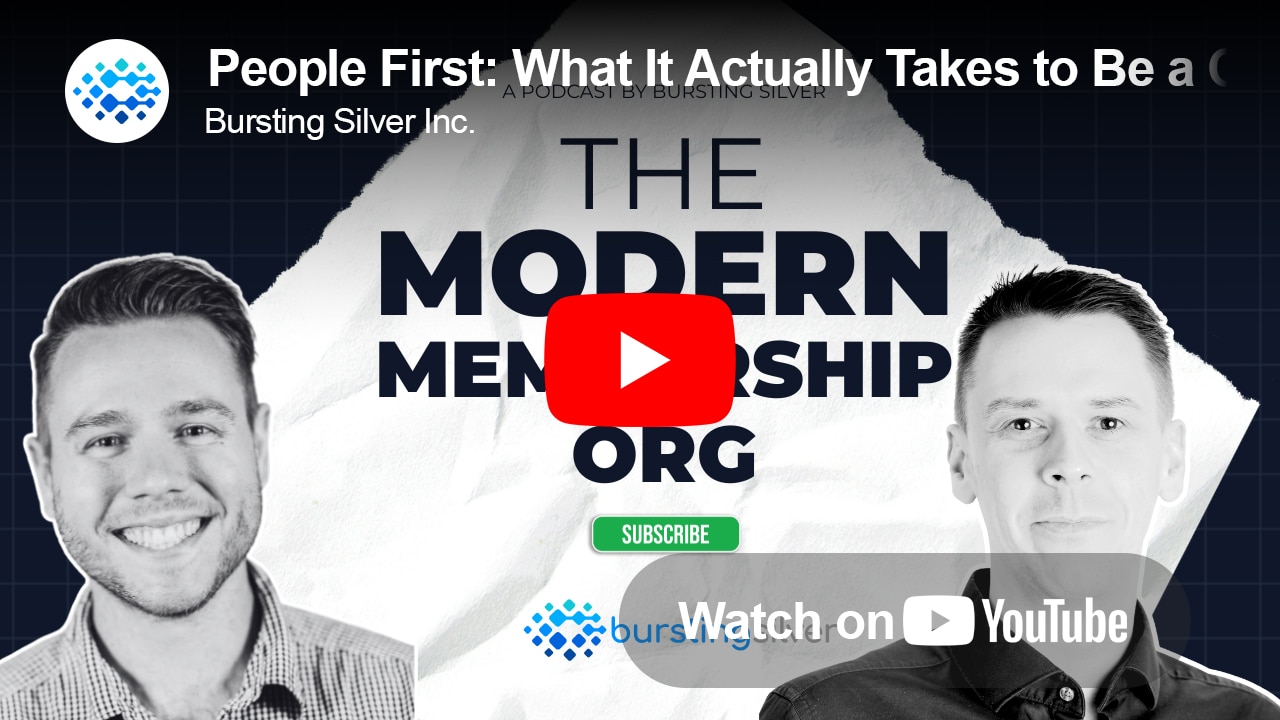
Episode summary
Most companies treat “great place to work” as a line for the careers page. Will Cooper treats it as a practice. As Bursting Silver’s Senior Manager of People and Culture, fourteen years a people, talent, and culture generalist, Ireland to Canada, Will is clear that his job isn’t to own the culture or hand everyone a rulebook. It’s to observe what the team has already built over 15 years, protect what works, and enable it to grow. That distinction sits at the heart of this episode, and it’s why Bursting Silver is now in its fourth year as a certified Great Place to Work company and has landed on the Best Workplaces in Canada list two years running.
Will pulls back the curtain on what that certification actually involves, and why it can’t be gamed. It runs on an all-employee Trust Index Survey scored across five dimensions (credibility, respect, fairness, pride, and camaraderie) paired with a culture brief. He explains why he can stand behind the results with a clear conscience: he has no control over what employees answer, no way to trace who said what, and every single employee email has to be submitted, including the people he suspects won’t give him a glowing score. The badge, he insists, is a point-in-time reflection of how people feel. Rely on it as your only metric and the culture behind it quietly slips away.
From there the conversation gets practical. Will walks Riley through the five values the team rewrote last year:
- People First,
- Client Centric,
- Integrity Always,
- Evolve with Intention,
- Driven by Purpose
He’s candid about the hardest part, too. Culture isn’t a checklist you complete; it’s ever-present work that busyness constantly pulls against. But it pays back tenfold. His closing advice to any leader is refreshingly un-glamorous: it doesn’t take a long list of fancy benefits. Invest in your people, remove the barriers to great work, and design around your team, not the company that makes a hundred times your revenue.
In this episode
- Why the Great Place to Work badge is a snapshot of how people feel in a moment — never the end goal — and how treating it as a finish line is exactly how culture erodes.
- How the certification actually works, and why it can’t be bought or gamed: an all-employee Trust Index Survey across five dimensions (credibility, respect, fairness, pride, camaraderie), plus a culture brief — with anonymity Will can personally stand behind.
- The five values Bursting Silver rewrote last year — People First, Client Centric, Integrity Always, Evolve with Intention, Driven by Purpose — and why Will can name every one without looking them up.
- What “People First” looks like in practice: manually screening every résumé, hiring for the person and not just the skills, and leaders who actually know their people at all levels.
- How a fully remote team stays genuinely close — the Gather virtual office, Slack, and the annual in-person retreat where first-timers say “I felt like I knew you already.”
- Will’s advice to any leader: it doesn’t take fancy perks. Invest in your people, remove the barriers to great work, and design around your team — because a great workplace is built by, and dependent on, its people.
Hosts & Guests
Riley Miller – Host
Sales and client success lead at Bursting Silver, helping membership organizations modernize iMIS, data, and AI workflows across North America.William Cooper – Guest
Senior Manager of People & Culture at Bursting Silver. Originally from Ireland, Will made the move to Canada in 2020 and has spent the last fourteen years as a people, talent, and culture generalist across hospitality, engineering, financial services, and technology consulting in Europe and North America. He studied human resource management in university, drawn early to what makes people tick and what drives them. He joined Bursting Silver in June 2023 and sees his purpose plainly: remove the barriers that keep people from doing the work they came to do. He owns Bursting Silver’s people strategy and its Great Place to Work certification.About Bursting Silver
Bursting Silver is a fully remote consultancy specializing in modern CRM, iMIS, and AI solutions for membership organizations across North America. We’re a 3-time Great Place to Work Certified company that helps associations, unions, and regulatory bodies modernize legacy systems, improve data quality, and deliver better experiences for staff, members, and registrants.
Our unique ability is finding the simplicity in the complex.






The Modern Membership Org Podcast
Full Transcript
Will Cooper: The other side is just: remove barriers to doing great work. Have a look at your processes, have a look at your policies. Make sure everything you do is designed around your people and your vision for your company — not just what everyone else is doing, or what’s popular right now, or what the company that makes a hundred times your revenue is doing in this space. You’re not competing with them. You should be designing things around yourself. A great workplace is built by — and is dependent on — your people.
Riley Miller: All right, ladies and gentlemen, welcome back to The Modern Membership Org podcast. My name’s Riley, here with Bursting Silver, and I’m joined by a special internal guest — one who probably hasn’t gone around the iMIS circuit, because he’s our in-house People and Culture lead. We’ve got Will on the stream to tell us a little about what makes us a great place to work. And not just to tip our own cap, but to really talk about the company values that Bursting Silver stands by — the things that set us apart — and what that’s done to improve our workplace here. So without further ado: Will, welcome to the podcast.
Will Cooper: Thanks so much, Riley. Happy to be here.
Riley Miller: Happy to have you on. It goes without saying that you’ve brought a special flavour to an already foundational, core-valuable piece of our people and culture. I’m really excited to get it straight from the man himself today, instead of just me going around saying it.
Will Cooper: Yeah, absolutely. When it’s only one of us, people tend to think we’re lying, or that we’re making this stuff up. But now there are two of us, and we can spread the message.
Riley Miller: Exactly. So for those who haven’t met you or heard about you — maybe give us an overview of what got you into people and culture on our team.
Will Cooper: Yeah, absolutely. I’m the Senior Manager of People and Culture at Bursting Silver. I’m originally from Ireland; I made the move to Canada in August 2020. My background in HR began when I studied human resource management in university. I’ve always had a big interest in people — in what makes people tick, and what drives them — so it felt like a natural decision when I was deciding what to study. I’ve spent the last fourteen years as a true people, talent, and culture generalist, spanning many industries: hospitality, engineering, financial services, and technology consulting, based mostly in Europe, North America, and beyond. There’s no single element of HR or people management that I haven’t been involved in to date.
Will Cooper: One of the biggest things for me is that I’ve always seen my purpose as people. HR, operations, talent — whatever name your company gives the role — I exist to remove barriers and guide growth and development, so that people can do the roles they came to work to do. No one should have to come to work and worry about the amount of admin or busy work they need to do just to stay afloat, or to get noticed. So that’s where I see myself.
Will Cooper: I joined Bursting Silver in June of 2023, and I was instantly blown away by the culture and the connection that was already built. I’ve overseen a lot of growth and change within the organization, and I’m really proud that — even with the changes, and with the length of time I’ve been here — our culture remains as strong and as central as ever. Our people, our clients, our leadership structure, our working environment, and our values: all of these are the components that really make Bursting Silver what it is, which is a great place to work.
Will Cooper: My responsibility to our company and our people isn’t to own culture and tell everyone what it should be, or what a book says it is. It’s to observe what’s currently happening — the culture our team has built over the last 15 years. I need to protect what works for our people, and enable growth with strategies designed around the feedback I regularly solicit, including our participation in the Great Place to Work certification process.
Riley Miller: Yeah, I’m glad you highlighted that. When we talk about “great place to work,” I think most people assume we’re just tooting our own horn. But there’s an association dedicated to benchmarking what it actually means to be a great place to work. Maybe you could set the table for those listening — what the organization is all about.
Will Cooper: Absolutely. Great Place to Work is an organization that serves as a certification and recognition platform — a badge of honour, essentially — for companies that stand out through their culture, their environment, and the trust that their structure and their people have built over time. It’s seen as one of the global standards for workplaces that are unique, or that do something that sets them apart — to the extent that Great Place to Work certified companies are sought after more than your standard company, because people know what they’re getting into. There’s criteria defined at the Great Place to Work level; companies who want to get certified have to meet that criteria, meet that benchmark, to be able to show off that badge of honour.
Will Cooper: Bursting Silver started working with Great Place to Work in 2023, just before I joined, and got our first certification in March of 2023. We’re now in our fourth year of being a certified Great Place to Work company. We’ve also been included in Great Place to Work’s Best Workplaces in Canada list two times over now — two consecutive years. That’s the top 100 companies in Canada. That list is recognized, so it’s a very significant achievement. But it reflects our culture and our people.
Will Cooper: It’s a snapshot, essentially, of how our people feel in the moment they’re providing that feedback. It’s not — and it should never be looked at as — the end goal. You can’t just earn the badge and say, “That’s it, I’m never going to do anything again to further my culture, or to build on this.” It also gives us a wealth of knowledge on the things people maybe don’t find as strong a pull for what makes us a great place to work. So it’s very valuable information — a significant achievement to get — but it reflects what you’ve already built. It’s not a be-all and end-all.
Riley Miller: And through the process, it’s very much a team effort. It’s not just spoken for from the top, or paying into some certificate pool. Maybe you could walk through what the process looks like to get that certification, and explain what’s involved — or is it just something anybody can jump into?
Will Cooper: Well, if it were, I’m sure we’d still have it, because I could talk all day long about things that make us a great place to work. But the certification process is actually quite rigorous. You can’t just fall into it, or pay Great Place to Work and get a licence and the badge. It’s a reflection of how things truly are — and that’s from feedback taken from your employees.
Will Cooper: The certification process is in two parts. The first is completion of a Trust Index Survey by all of your active employees in a given country — for us, that’s Canada. The survey assesses your company, and how people feel about it, across five different dimensions. Credibility — how much people trust your leadership and your business, and believe what you say. Respect — how people feel when they come to work: do they feel accepted, listened to, and part of your company. Fairness — that people feel your decisions and your processes reflect an equal opportunity for everybody. Pride — people want to work at companies that are value-driven and that work in meaningful spaces. And camaraderie — how much of a team feel there is to working at your company. The survey has many questions within each of those dimensions, and you get an overall score at the end. We’ve been very lucky at Bursting Silver that the people who have built our culture and our environment rate it incredibly high. I’ll get into some of what makes us a great place to work in a few minutes.
Will Cooper: The other side of the certification process is a culture brief — and this is where I have involvement. The culture brief is a profile where you detail many areas of information about your company: what you believe makes your company special, what you’d say your company does differently, the things that define your company. But it also takes into account your demographics, your size, even your revenue. It takes all of these into account so it can associate your scores with those criteria — and that’s how you end up placing, either with the certification or on the Top 100 Best Workplaces lists each year.
Will Cooper: One of the reasons I like Great Place to Work as a metric — one that I can stand behind — is the integrity of the process, and of the engagement as a whole. It’s very difficult these days to tell an employee that if something’s anonymous, it truly is anonymous. I can say, hand over heart, that when I submit the list of our employees’ emails — and you must submit every single one; you can’t leave out someone you think won’t give you a great score — they still have to be included. They vet this as well.
Will Cooper: One of the biggest things for me is that I have no control over what’s answered. So the results I get at the end, based on the Trust Index Survey, are real — they’re a true reflection. And I stand over the anonymization, because I’ve no input on what gets said, but I also can’t figure out who said what. The majority of the survey is quantitative, and unless you have a large enough sample size — I think it’s over six people in your exact same demographic — it’s impossible to identify who answered what.
Riley Miller: And that level of anonymity — for organizations who might not be at the top level of the Great Place to Work scoring — is really important. That’s how you get the true feedback, and I’m a big believer in that. I don’t care who said what; I care that it was said. And that’s a big part of our Great Place to Work survey each year.
Will Cooper: That’s the reason I can stand over it. It’s one of the most integrous solutions I know of out there to really acknowledge your success and your culture.
Riley Miller: Having been part of many of those surveys, I can speak to it too. It’s one of those deliberate reach-outs from the team to make sure we’re all participating, because it does mean a lot — and it means a lot to get heard, which I think is often overlooked. And to that note about anonymous feedback not being so anonymous: any feedback I’ve given has been addressed at an all-hands, but never directly to me — never a “hey Riley, I know you sent that.” It’s taken into consideration, and genuinely valued. Especially in terms of how we earn that recognition — it’s a group effort. That’s something James Harrison and I, when we talk to new clients, we tout the Great Place to Work recognition, because it’s built off the whole team.
Will Cooper: Yeah, absolutely. It really is.
Riley Miller: So when we consider how we earn it, and what makes up the Great Place to Work process — what makes your people strategy at Bursting Silver so strong in meeting that criteria, or even in reflecting what’s already been built here?
Will Cooper: I could go on forever. It’s one of the things that makes my job so easy, honestly. When it comes to recruitment, it’s an easy conversation the majority of the time. It’s always nice to be in a position where I can tell people about this company they may not have heard of before, and have them leave interviews going, “That’s absolutely something I want to be part of.” That shouldn’t be overlooked — how unique that is in every workplace, in every environment. If you can say that, it’s a pretty good starting place. But this isn’t something we fell into accidentally. It’s a very intentional enablement — allowing a culture to grow and flourish. It starts with every decision, every process; it’s the basis of everything that follows.
Will Cooper: Last year, one of the big things I worked on was updating our values. It was a very intentional change. Our company values, our ethos — they did reflect our company, of course, but what we were finding is that there was so much more that wasn’t captured. We considered the qualities our people possess, and what makes Bursting Silver successful, and we wanted our core values to really reflect the true Bursting Silver — not just lip service, or something we display on an onboarding slide and never mention again. If you ask people six months down the line — if you ask many HR people to name their company values — they struggle. I know all of ours, because all I have to do is think about our company and the people who are here.
Will Cooper: We are People First. We are Client Centric. Integrity Always is the way we work. We Evolve with Intention — we don’t change things for the sake of it; we evolve to make sure things continue to grow. And we’re Driven by Purpose. We exist in a very niche corner of the market, and that purpose — that meaningful work — is really what drives what makes Bursting Silver so successful.
Riley Miller: And we work in the nonprofit space. Even when I was talking with Doug Morris at ASI, a lot of what he called back to — why he does what he does — is that he loves working with people who want to make a difference. I think that runs true with our organization too. We have more people reaching out to apply because they appreciate our values, and it’s our opportunity to suss out the individuals who really are looking to reflect that value too.
Will Cooper: Absolutely. We’ve seen, with our engagement with Great Place to Work, our applications grow year over year. Every time I post a role now — the last figure I have is that, over the last three years, we’ve increased the number of applicants for every role we post by 300%. So it’s no small feat. The badge is not your end goal, but it definitely gives a lot of credibility to what you’re building, and what you’ve built. People want to be a part of that. And you switch from the mindset of “tell everyone about Bursting Silver, because this might be your one opportunity to sell what a great company it is,” into more of a “here’s what we offer — now let’s talk about where you’d fit into that.” That’s a really nice place to be when you’re recruiting. And I think it sets the right standard for you as a candidate, if you want to become part of this.
Will Cooper: Everything is up front. You see the whole picture before you join — there are no surprises. It’s a really nice place to be, as somebody in my position. It makes things a lot easier.
Riley Miller: So when we think about the benefits, or the company culture we’re living and breathing — one thing the team highly respects is work-life balance, and making sure that people in a remote-work scenario appreciate a separation between their work and their life. I’d like your opinion on how you think Bursting Silver has approached that balance — and whether it’s sustainable.
Will Cooper: Yeah, absolutely. It’s the company culture — it’s acknowledged and recognized that all of our people work here and have their own lives outside the roles they hold at Bursting Silver. We celebrate that in many ways, and we encourage people to bring their authentic selves to work. Even through our recruitment and onboarding process, we feel strongly that your experience and your skills are one element to consider, of course — but you’re in a pool with so many other people who maybe possess exactly the same as you: the same education, the same experience level. What really sets you apart is the person that you are — your interests, your values, your hobbies. That tells me more about you as a person, and that’s really where we make our decisions.
Will Cooper: I made a commitment when I started at Bursting Silver that when people apply for roles here, I’m going to manually screen every résumé that comes in. As I said, we’ve grown our applications since I started, but it still holds true — I still do that. I feel like we’d miss out on too much of what makes people great if we relied too heavily on automation in that space. And that really is People First: it’s not just a value, not just something we write down. It’s the common thread, the common theme, that runs through absolutely everything here.
Will Cooper: In terms of sustainability — is it a fad? Is it just because I’m in my position? No, absolutely not. It was here before me as a mindset, and it will be here long after, if I’m ever not here. All of our leadership decisions are made with people in mind. Our leadership team communicates regularly through our all-hands meetings — every month or every six weeks — and through all their internal updates. One of the things I really respect, which I haven’t always seen in my career, is that our leaders stand over the decisions they make. They communicate them; they don’t ask someone else to do it on their behalf. And they take all kinds of feedback openly, with an open mind. Too often you get instances where, if someone comes up with an idea, they’re very defensive of it — and that’s not the case here. I’m grateful to work in that environment, and to be one of the go-betweens who generally hears a lot of the feedback firsthand. But it’s always nice to know it’s not going to just finish with me — it goes back to people who can really move the needle.
Will Cooper: One of the things I was incredibly shocked by when I started here was that our leadership team has a deep knowledge of all of our people, at all levels. It’s usually my position, when I go into performance reviews, to be the one presenting information — “here’s employee 267,” or whatever it might be. But that’s not the case here. Our whole leadership team knows pretty much everyone: how people are doing, what development opportunities they’re interested in, what they’re working on. I’ve never experienced that before, and I think it goes all the way back to the respect the company has for people. It starts at the top, but it definitely bleeds down through everybody.
Riley Miller: And that calls into the point about being remote — and being spread out all over the place. From an organization perspective, from a people and culture perspective, where’s the line between the benefit of being remote-first, and the risk to culture of being isolated that way?
Will Cooper: Having never experienced a culture as deep as ours — an engaged and supportive environment — it’s something I hadn’t actually considered ahead of time. I just saw it as a benefit: who wants to sit in traffic for an hour each way to their office? We’ve been remote for the last fifteen years; it’s always been our culture. There are a few elements that make it a benefit, and the risks are there, of course. When you hire someone remotely, you never really get the full picture — are they as engaged once they start as they were in the interview, once that scrutiny is gone? We have a few elements in place to protect that; our hiring is very deliberate. I always say it’s not fully remote — it’s remote first. Even when we have things in person, where three or four people meet in one of our main hubs across Canada, we’ll always have the virtual setup as the primary concern. The remote-first element is the important bit: we enable people to work from wherever they might be.
Will Cooper: I haven’t seen the risks play out at Bursting Silver, because we have our own ways of managing that. Take our technology stack: we have a virtual office called Gather that we use as our primary source of communication. We’ve obviously got Slack — everyone has Slack, or a version of it — but not everyone has as strong a culture as we have. Gather is a little 8-bit virtual workplace. Everyone has their own desk; they can customize it, and their avatar. You walk around, go to meeting rooms, go to somebody’s office if you want to talk to them. It’s no different than the majority of the world’s offices — and it doesn’t feel that way anyway. It allows for really quick interactions: you don’t need to add a 30-minute meeting to your calendar if you have one question. You just wave to the person, it sends them a little notification, and they’re either available or they’ll get to you. So many little hallway conversations, so many virtual events, run in Gather — because it’s just like being in an office, except you’re not. We have video and text capabilities; it’s an almost perfect solution for feeling engaged. You sit in pods with your own team and have focused work and team sessions.
Riley Miller: That’s great — it really is.
Will Cooper: We also run virtual social events throughout the year. Even when we have an in-person social event — at one of our main hubs, where the majority of our people are based — we’ll always have a corresponding virtual event follow it, or precede it, a few weeks out. It allows everybody to get together through the year. But people are still a box on a screen for the whole year — and that can run into many years, depending on how long people exist in cultures like that.
Will Cooper: The one thing I believe makes our culture stand out is our in-person retreat — our annual company retreat. It’s legendary. There are many, many stories, and they’re all good. That’s what struck me when I first heard we were doing it: I got the HR panic of “oh my god, there are going to be waivers, it’s going to be like the news, someone’s going to miss their flight, this is going to be awful, I don’t want to be involved in this.” But it doesn’t go that way. People are so engaged in our retreat. Our annual retreats are an opportunity for professional development, and we run a give-back initiative every single year, where we give back to the communities we travel to. But the most important bit — the bit that stands out the most — is that it’s in person: the time we get to spend with each other. The unique thing that people who go on their first retreat always point out is, “I felt like I knew you already.” Even if they haven’t met me in person and it’s just been Gather, they feel like they know me, or their teammates, or people across the company — because of how we use our technology to enable us to feel close together. It’s a unique benefit — not every company has that luxury anymore. Each company needs to decide what works best for them. I know this wasn’t a change that happened six years ago; it’s the way we’ve always worked, and it’s something we build a lot around. So it definitely works for us.
Riley Miller: My favourite thing with the retreats — outside of the give-back initiatives, like making bikes for the Boys and Girls Club in Nashville, or building houses in the Dominican Republic, which are all very feel-good — is getting to see the team, and the amount of “I thought you were taller,” or “you’re taller than I expected.” Those are always fun. And there’s the callback to the Gather rooms, too. I remember when we first put that in, people were going through costumes; there was a little room where you could do a race-car thing. For those listening who know Habbo Hotel, or have ever been on one of those 8-bit games — there was a Coca-Cola game back in the day, just 8-bit, top-down, run around.
Will Cooper: Someone actually asked me in a cafe once whether I was playing Pokémon on my laptop. I thought that was so funny — at a quick glance you might think so, but it’s also work, and it’s kind of nice that it feels that way.
Riley Miller: I’ve gotten that from my better half as well, looking over my shoulder. So — all of this sounds amazing from the outside looking in. But I’m curious: you’re saying the partners know everybody, and coming in you already had a good foundation of team values you could amplify. Is there anything you’d still consider hard, from a people and culture perspective?
Will Cooper: Absolutely. As I said at the beginning, it’s not my job to enforce culture — but it’s also not a one-and-done, complete-the-checklist activity. This is every decision, every new hire, everything. It’s intentional. If you don’t build your strategies, your decisions, your changes around your culture and the people who built that culture, you don’t actually have anything. You can go and get your certification, but as I say, that’s a point-in-time review of how people are feeling when they answer the survey. And while it comes with many benefits, if you rely on that as your only metric — your indicator of completion — it’s not going to last. It’s a forever thing. Our structure, the strategies we put in place, the people who are here, the way we hire, the benefits, the meaningful work we do — those are the things that allow us not to feel overwhelmed by it. Our culture has naturally developed over the years; it’s driven by the people who work here, guided a little by me, the partners, and the leadership team. But it takes everyone engaged and pulling together to build and maintain that distinct culture.
Will Cooper: One of the things that always strikes me is that when I talk about Great Place to Work, or about the things we do at Bursting Silver, people always say, “I thought I had a good job,” or “I wish I worked there — compared to you guys, this is just different.” And it’s one of those things: if you ever take your eye off it for too long, or you stop caring, or you get complacent, it goes away so fast — and it’s very difficult to build back up. I know from previous experience that trying to convince people “if you just invest in this thing, it’s worth it in the long run” is hard. It’s an investment now — of time; it doesn’t even always have to be money.
Will Cooper: Really, what I’m here for is to make sure the busyness and the external factors of everything we do — which can definitely distract from our culture, and make people not want to engage in a lot of things, especially if you don’t keep an eye on how busy people are — don’t take over. My job is to keep things on track, keep giving those opportunities, keep enabling those little additions to the culture here and there. That’s the bit that’s really important. It’s hard, because it’s ever-present, and it doesn’t go away. But it also pays out ten times over to have a great culture. When things don’t go right, if you have a great culture, people are a little more forgiving — you tend to get another shot at things. Whereas if people are already annoyed at where they work and their environment, their level of forgiveness is probably a lot lower. So I’m definitely grateful for it. It is hard work — it’s one of my favourite things about my job, and probably one of the toughest, too.
Riley Miller: Well said. I think having that ever-present connection to it is the payoff. If it was all easy, it wouldn’t be worth it, I think. Now, looking at the time — this has been an excellent conversation, especially from my perspective: rah-rah, go team. But I’d like to take this opportunity to give you a chance for a takeaway to other organizations — ones that might be struggling from a remote sense, or looking for easier ways to start improving their own values and their own people and culture environments. Turning it into a good takeaway from a leadership perspective: what’s one piece of advice you’d give to other people teams and leadership, to start building this foundation?
Will Cooper: I’m very aware that we’re privileged at Bursting Silver to be in a position where we can offer perks, benefits, and a retreat. But the truth is, it doesn’t take a long list of fancy benefits to build a great place to work. My advice is: invest in the knowledge of your people. Spend time getting to know what drives their ambitions, and their reason for doing the work they do. The other side is just to remove barriers to doing great work — have a look at your processes, have a look at your policies. Make sure everything you do is designed around your people and your vision for your company, not just what everyone else is doing, or what’s popular right now, or what the company that makes a hundred times your revenue is doing in this space. You’re not competing with them. You should be designing things around yourself. A great workplace is built by — and is dependent on — your people. Remember that: it’s not all on your shoulders. Without people, most of our businesses cease to exist, or we become sort of robotic shells — and that’s not the business I’m in. Use that knowledge as your guiding principle. Hire intentionally. Enable engagement where you can. And most of all, don’t see culture as a task to check off. Embrace it as your greatest asset — because for sure, at Bursting Silver, it is.
Riley Miller: Awesome. Well said. Will, I really appreciate your time. Thanks so much for coming on, and for sharing some highlights and insights about how we’re structured, and what it means to be a great place to work.
Will Cooper: Absolutely, Riley. Thank you so much for the opportunity.
Riley Miller: Anytime. Take care, Will.
Will Cooper: See you.
Riley Miller: All right — that’s a wrap. Thank you so much for listening, and thanks to Will for jumping on this episode. I can obviously talk all day about the things we’re doing and how awesome it is here, but I think it actually means more coming from Will, because he can give some perspective on what really goes into making all this work. So that was awesome to have him on board. If you’re looking for more information on Great Place to Work — or anything else — those show notes are in the comments. If you haven’t already, please consider subscribing. We’re on YouTube, Spotify, Apple Podcasts — all of the platforms. This has been The Modern Membership Org podcast. My name’s Riley, from Bursting Silver, and we’ll see you on the next episode next week. Take care.
Modernize Your Organization With Confidence
You deserve a modern platform that supports your mission without increasing complexity.