
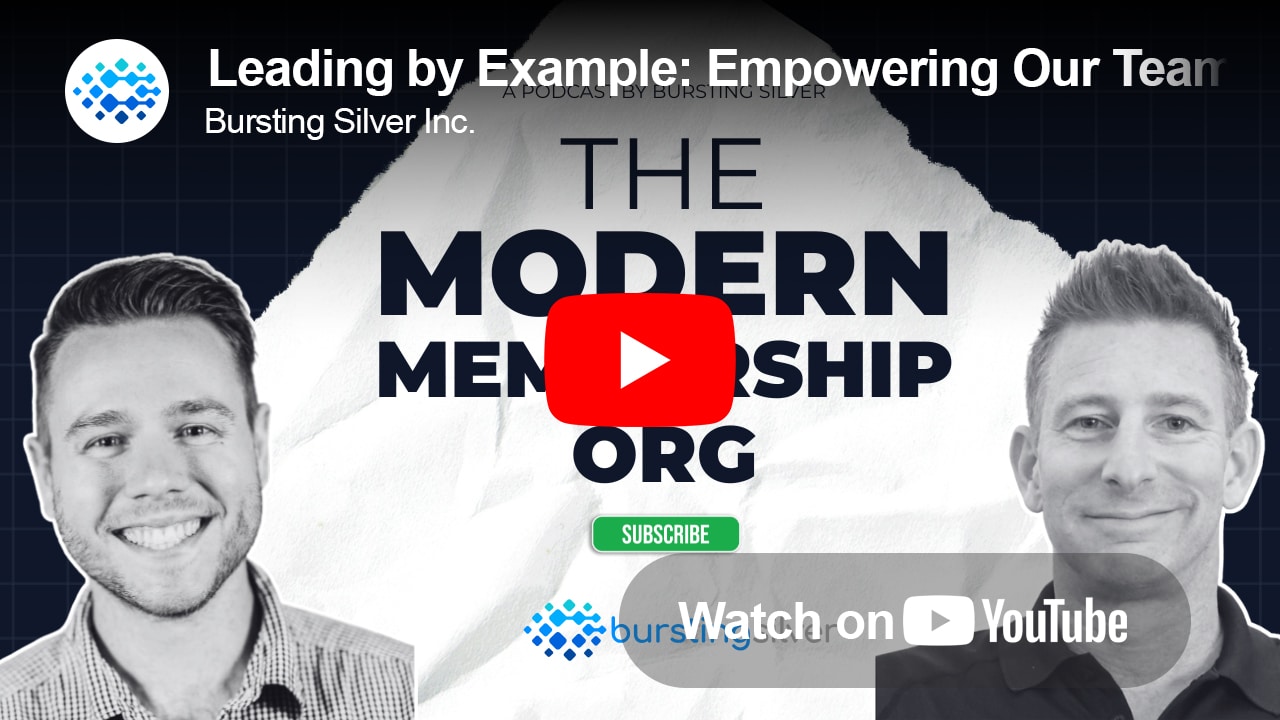
Episode summary
A year of informal AI adoption at Bursting Silver, working groups, lunch-and-learns, hackathons, ChatGPT access for everyone, proved one thing: informal can’t keep up with how fast this moves. At a company retreat in St. John’s, Newfoundland, the effort got a name and a mandate: Project Navigate, a formal 12-month program with a single objective, faster and better client service.
CEO Al Povoledo walks through how it’s built: a small working group meeting at least three times a week with the CEO in the room, and four pillars, a competency framework with a self-assessment, optional training paths, policies and guardrails, and the tools themselves. He’s candid about the hard parts too. Client member data never enters BSI’s AI systems (“It’s not ours”). AI-polished reports get called out; the culture is head start, not replacement. And for leaders wondering where to begin, Al offers the kickoff question he’d ask any organization: “Are we ready?”
In this episode
- From informal to formal. A year of working groups, lunch-and-learns, hackathons, and company-wide ChatGPT access, and why the end of that year demanded a formal program with a name, a structure, and a deadline.
- A working group with teeth. Hired guns rather than volunteers, subject matter experts pulled in at the right time, a minimum of three meetings a week, and the CEO at the table. “You can’t just delegate this and say, all right, go do this AI thing.”
- Four pillars, twelve months. A competency framework that defines where people need to be by role and level, a self-assessment to find the gaps, optional training paths, policies and guardrails, and the resources and tools to put it all to work. Four stages, two to three months each.
- Governance as an enabler, not red tape. Riley’s “guardrails on the bowling alley”: when the team knows where the safety zone is, they move faster inside it. And the hard rule underneath it all: client member data does not go into AI systems.
- Standardize half, experiment half. How the working group handles the flood of home-built skills and connector requests: review everything, merge the best pieces, publish BSI standards, and still leave real room for people to try things on their own.
- A head start, not a replacement. Catching the six-page management report that took half an hour, and moving the team from outsourcing judgment to using AI for legwork while the thinking stays theirs.
- The kickoff question. Before tools, before strategy decks: are we ready? Are people willing to learn, to try things, to do their jobs differently? Honest answers only.
Hosts & Guests
Riley Miller – Host
Sales and client success lead at Bursting Silver, helping membership organizations modernize iMIS, data, and AI workflows across North America.
Al Povoledo – Guest
CEO and one of the original founders of Bursting Silver. A return guest from Ep 2 (Association Leadership in 2026) and Ep 4 (Union Modernization), Al leads BSI’s AI adoption effort personally, from strategic objectives down to the weekly release plan.
Resources
- Free AI adoption checklist — areas where you can start adopting AI in your own workspace. https://www.burstingsilver.com/ai-readiness-checklist-for-membership-organizations/
- The Bursting Silver blog — free articles on AI governance and adoption: https://www.burstingsilver.com/blog
- Ep 5 — AI for Non-Profits: Real Applications, No Hype — the “start small, fail quickly” framework Al references: https://www.burstingsilver.com/podcast/ep5
- Ep 8 — Quick Win AI Use Cases — practical first projects: https://www.burstingsilver.com/podcast/ep8
About Bursting Silver
Bursting Silver is a fully remote consultancy specializing in modern CRM, iMIS, and AI solutions for membership organizations across North America. We’re a 3-time Great Place to Work Certified company that helps associations, unions, and regulatory bodies modernize legacy systems, improve data quality, and deliver better experiences for staff, members, and registrants.
Our unique ability is finding the simplicity in the complex.






The Modern Membership Org Podcast
Full Transcript
Al Povoledo (00:00) I think they’re taking it more seriously. I think people are realizing it’s not going away. I think people are realizing that, hey, this is going to impact the way we work. Most importantly though, it’s important for people to realize that this isn’t going to take away your work. It’s going to change the way they’re working.
Riley Miller (00:49) What’s going on, everybody? Welcome back to another episode of The Modern Membership Org podcast. My name’s Riley, here with Bursting Silver, and today we’re going to be talking about innovation and how that can make a holistic change on your organization through the power of AI. I’m really excited to introduce a return speaker here. He’s been here from the very beginning — we’ve been getting out and talking about how to improve your organization, and the mindset from an executive level for association leaders. Welcome back to the podcast, Al Povoledo.
Al Povoledo (01:17) Thanks, Riley. Great to be back. And love your shirt.
Riley Miller (01:20) Thanks. You too. It looks good. Where’d you get that?
Al Povoledo (01:24) I don’t know — we must shop at the same store.
Riley Miller (01:26) Must be. Just this old thing, I just picked it up. Well, you’ve got to rep the colors, right?
Al Povoledo (01:32) Exactly.
Riley Miller (01:34) For those that haven’t heard the previous episodes — I think it was two and four — maybe give a brief introduction and let them know who you are and where you’re from.
Al Povoledo (01:43) Yeah, for sure. Al Povoledo, CEO of Bursting Silver and one of the original founders. Today, my understanding is we’re talking about AI adoption. We spent a couple of episodes several weeks back talking about it — we don’t need to rehash the lessons learned there, but at a high level it was: start now, start small, do some meaningful stuff, be agile, fail quickly, move on, that kind of stuff.
I think the timing is good to have this conversation again, because BSI as an organization is also going through this. So I thought it would be a great opportunity for us to share our learnings, our failures, and what we’re trying out with the community, so that they can learn from us.
Riley Miller (02:26) Yeah. And a big thing I wanted to get from this conversation today, at least for our listeners, is that based on our experience, maybe they can glean some ideas on where to get started, or it can inspire some conversations with their own team. So coming from the root of this episode: we have a new AI adoption program. Maybe you can walk us through what that big change looks like for Bursting Silver.
Al Povoledo (02:49) Sure. It’s a new program that we put in place. Just to back it up a second, you need a little bit of background in terms of what we’ve been doing at BSI. About a year ago, we decided that we needed to jump on this train called AI that was coming at us pretty quickly. And what we did was put an informal program together where we introduced AI to the organization. We did things like putting working groups together, idea sharing, lunch and learns, hackathons. We gave everybody access to ChatGPT. We did training sessions, that sort of thing. It was all pretty informal.
But at the end of the year, we decided that, hey, this stuff is moving so quickly, we need to formalize a program. And this all culminates to where we are right now, where we’ve put a formal program together that we’ve actually called Project Navigate. And that’s what I think we’re going to talk about today.
Riley Miller (03:45) Yeah. Just looking back at where we’ve come from as well — it’s moved so fast, and adopting it as part of our everyday processes was an example of figuring out where it could work in our everyday, what it works like with the teams. I remember those hackathons and lunch and learns and share-athons. And it’s exciting to see that now formalized and put into principle. The things that we talk to our clients about, now we’re doing internally as well, and taking those learnings. So for Project Navigate, maybe we’ll start off taking a look at: what’s the name for, and how did it come to be?
Al Povoledo (04:22) Sure. We actually had a company retreat in St. John’s, Newfoundland a few weeks ago, and of course there’s a bit of a nautical theme there — it’s on the water, et cetera. We brought everybody in the company together and we went through some AI training together for a week. And then what we realized was: okay, great week, we learned a lot, but this has to continue.
So we went with the nautical theme and said, all right, let’s call this thing Project Navigate, and let’s put a program together that’s going to continue this AI initiative over the next few months at BSI. That’s where the name Project Navigate came from. Like I said, it’s a more formal structure, and it’s based on some program pillars. We can talk about exactly what those are, but the themes are around training, providing tools, and providing policies to operate our business and to serve our clients. That’s the program in a nutshell.
Riley Miller (05:14) Right. And there are many ways to go with that — it sounds like a big undertaking. So for the specifics of the actual program, who’s driving it? And we can touch on what those pillars look like for the foundation of it.
Al Povoledo (05:28) In terms of who’s working on it, we put together a working group. We realized that we couldn’t do this off the corner of our desks, and that we needed a group of people that could drive this thing. We thought about getting some volunteers together — and we actually decided not to do that. What we decided to do is bring some hired guns within the company together to create this working group, people who brought different specialties to the table. And then we supplemented that team with subject matter experts, or SMEs — and as you know, you’re one of them. We bring in the right people at the right time. But there’s a core group of about four people, and we meet regularly, minimum three times a week and often more, to drive this program.
One of the big things I went into this with — from listening to other podcasts and reading a lot and seeing what other companies are doing — is I realized that a big endorsement from senior management was required. You couldn’t just delegate this and say, all right, go do this AI thing. You have to be involved. So I’m very much involved in the process. I go to all the meetings. We talk about very granular stuff, very specific things, very tactical things, and very strategic things at the same time.
And what our group did is put together a series of objectives that we wanted to accomplish over the next twelve months.
Riley Miller (06:52) Yeah, and I like sitting in the seat too. I’m not on all the meetings, but I jump in where relevant, and it’s nice to add that little bit to the conversation. But for the project goal — why the twelve months?
Al Povoledo (07:05) Well, you can’t go much longer than that. This stuff is changing on a dime. What’s happening this week is going to be very different from what’s happening next week. You hear about three- or four-year roadmaps, or five-year strategic plans — that just doesn’t apply in this world. In this AI world, twelve months is almost too long. We’ll talk about what we’re doing in the various stages of it, but twelve months just seemed like the right number for now. It actually might be shorter. We’ll see. But it certainly couldn’t be longer than twelve months.
Riley Miller (07:37) Well, we’ve hinted at it. Let’s get into it. What did the working group come up with in terms of that plan?
Al Povoledo (07:43) The first thing we did was define our objectives in terms of what we wanted to achieve for the business. I don’t need to get into the specifics, but essentially we wanted to provide faster and better client service. That’s the overarching theme. And to get there, we needed to be enabled by AI, obviously. So we defined four stages — each stage is between two and three months — and each of those stages achieves certain objectives. And like I talked about earlier, there are these pillars of success, these essential themes that we wanted to hit for each one of those stages.
Riley Miller (08:20) Right. And so for the goal — being empowered by AI and working faster — is that split across each of those pillars, or how do the pillars play into that goal?
Al Povoledo (08:32) The four pillars support the objectives of the program. And I’ll tell you what the four pillars are.
The first thing is we wanted to introduce a competency framework. So what’s that? It’s just a fancy word for defining exactly where people need to be as far as their AI understanding, at their certain point in their career, their position, their level in the organization. It’s almost like a rubric or matrix: if you are this many years of experience, a consultant, non-technical, for example, this is what you should know about AI right now. A stake in the ground, so people can gauge themselves in terms of where they’re at.
How do people gauge themselves? That’s the second thing: providing an assessment. We gave people a tool that allows them to self-assess and see where they are within that framework.
And once they understand where they’re at, we had to give them training programs. That’s the third pillar. We’ll talk about some of the training programs we put in place.
Now, once people have that training, they have to be guided by policy and guardrails, because you can do a lot with AI, and it can be pretty dangerous if you’re not careful. So policies and procedures around that — that’s one of the pillars.
And lastly, the last pillar is resources and tools. That’s the big one: giving people the tools they need to do their job. When I say tools, these are things like agents and skills and connectors and plugins, and access to those things. And quite frankly, time, so that they can try things out.
So those are the pillars: competency, assessment, training, policy, tools. Those are the key ones.
Riley Miller (10:20) Yeah, so it’s an enablement program, essentially. Build up the team and get them knowing the tools. I think the empowerment part is the thing I’m excited about, because we live in such a saturated environment — this open world of what AI can do. You can see different training programs daily on YouTube, or scrolling Instagram. It’s hard to suss out where you need to start. Having a self-assessment is, I think, a really cool way of finding those gaps and then pointing you in a direction, or to a training platform that walks you through where you’re at.
Al Povoledo (10:58) Yeah, absolutely. It’s a starting point for sure. And I do want to emphasize this: our training program is essentially to get people started. It’s the basics — let’s say the first thirty, forty percent of it. There aren’t any training programs out there — because this stuff’s moving so quickly — that are going to teach you A to Z. But we want to get people going so that they can then go off and experiment and try things on their own.
What I’m trying to say is: this is not a prescribed program where you take these courses and by the end of it you’re an AI expert. There’s no such thing right now. It’s really an enablement program.
Riley Miller (11:37) Yeah. I mean, there are self-proclaimed experts online, but I’d agree the point of this program is not to be able to code your next AI platform. But understanding it is huge. And that goes into knowing the tools and connectors and how to use them effectively. I preach having an AI governance policy a lot. I’ve spoken at iUG about it, and I’ve written articles on just how important that is: to give the team the barriers, or the guideposts — the guardrails, so to speak, on the bowling alley. Because then they know where to operate, and where the safety zone probably is for how to use these tools.
Al Povoledo (12:16) Yeah, super important. AI — bots, agents — can ingest so much information and so much data, and you just have to be careful what you give it. Specifically, in our world, it’s client data that’s confidential to them. They trust us with their data. So we need to be really careful in terms of what we ingest into our AI systems, so that we can enable our skills and help our clients in return. Super important.
Riley Miller (12:48) Walk that walk. And I know, too, when it comes to the resourcing, that we can run off and create tons of skills — you get plenty of ways to skin a cat, so to speak. And connectors as well: people can request new tools to attach to their Claude and have that running in the background for their specific task. How is the working group managing that big spread of requests and skills?
Al Povoledo (13:17) Actually, that’s the hardest part of what this program’s about. Putting training together, putting some policies together — easy peasy. You can leverage AI to find those kinds of tools. But the real magic is enabling people with those tools. So what are those tools? Like you referenced, there are Claude skills, plugins, connectors to other applications, that sort of thing.
What we noticed is we got a lot of feedback from everybody saying: hey, can we get that skill? Can we bring in this? Or, I built this skill — can we connect to this system? If you’re not careful, you’re going to have this huge infrastructure to manage, and people are going to be pulling in stuff and using data that you shouldn’t be, perhaps. Or they’re going to be using skills and plugins that may not necessarily be the right ones.
So there’s an element of standardization that you have to have, and that has to be balanced with letting people try things out on their own. It’s kind of like a fifty-fifty game. In terms of standardization, what our working group is doing is specifically defining skills and standardizing — saying, these are our BSI standards. For example, the one you did, the branding one: standard BSI templates and that sort of thing. Everybody uses that. That’s a pretty straight-up one.
But we also have people going off building — I built a business analysis skill, I built a skill doing this and that. So part of the group’s responsibility is to look at all those, try to find the best ones, bring in the pieces from the other ones that can make that one skill better, then standardize that and roll it out.
At the same time — I’m saying standardize a lot — again, that’s only fifty percent of the game. There have to be a lot of trials and people doing things on their own, because we just can’t push out one set of tools and say, this is it. We have to enable people, just like we were talking about earlier.
Riley Miller (15:10) Yeah. It’s also nice to see, even just from last year’s dipping a toe into ChatGPT — building our own GPTs or project folders and sharing amongst the teams — there was a way to work with the team, to get creative, to find new ways to skin a cat. But I think this is now the collective effort coming back in and sorting through the gems. That’s really cool.
Al Povoledo (15:31) Absolutely. A bunch of cowboys going off doing their own thing — and cowgirls — and now we’ve got kind of a rodeo going on. We’re all in the same place. Maybe that’s the analogy. I just made that up on the fly, so I don’t know if it’s any good.
Riley Miller (15:43) You heard it here first: the BSI Rodeo. So now — we’re still early days with the program, and you’ve got the team putting together resources and courses, basically setting up the farm for people to come in and start to look at it. How is the rollout looking for the project?
Al Povoledo (16:07) I’m pretty proud of it. The way we’ve rolled it out has been fairly successful to date. The first thing is we branded it. We called it Project Navigate, tied it back to our company retreat, to keep the momentum going from that training we did.
We do a ton of communication — a lot of messaging out through our company communication channel in Slack. We do weekly updates and tell people: here’s what we’ve released this week, here’s what’s coming, that sort of thing.
We put a website together specifically for this initiative. People can go to that website, understand what the stages are, understand where we are in the program, understand the objectives — and even more importantly, go there and pull down skills, connectors, those tools we’ve been talking about. They’re all on the website, so people are pointed in the right direction. There’s one home for where people can find those things. The courses, the training, the policies, the procedures — that’s all on the website.
So communication and access to that information is hugely important. And like I talked about earlier, the working group we put together meets a lot — multiple times a week. We’ve got a big accountability structure in place to hold ourselves accountable, and that’s super important. Our to-dos and our deadlines are hours and days. We’re not saying “in a couple of weeks.” We’re just moving fast. And I really love that — the way we’re operating.
Riley Miller (17:30) Yeah. Communication guy here — I’m a big fan of communicating clearly. But when it comes to launching something like this, where there are so many ways to look at it, so many different opinions on AI especially, I think getting the messaging right first is extremely important to the success of the project. So I’m really excited to see how the team takes to the rollout, adopting it, and seeing what the feedback is on the things that were built as well. I’m personally invested, because I was also part of it. But it’s exciting to see.
Al Povoledo (18:04) Yeah. And so far, so good. At some point in the next few weeks we’ll put out some sort of survey, or an informal “hey, how are we doing here?” and we’ll see. But my gut feel is that people are seeing it and going: okay, this is great. I’ve got the infrastructure here, the tools, the program, so that I can expand my skills as far as AI is concerned and help our clients. So it’s feeling good so far.
Riley Miller (18:32) Now, I wanted to touch on the privacy and confidentiality piece. As an IT company and consultants, we have the trust of our clients, and we play by those rules — we walk that privacy walk. But for a leader listening here, trying to instill a lot of those best practices themselves, with their organization and their teams: how important is it for a program like this to keep that data privacy and confidentiality at the forefront?
Al Povoledo (19:00) It’s job one. It’s huge. A little background: we work with dozens, hundreds of clients, and we have access to their systems and their files. There’s a trust there; there are confidentiality agreements in place. And specifically, we have access to their member data — for example, if we’re working with an association or a union. So we simply can’t open up our AI systems and ingest that information about our clients, specifically that member information. We can’t. It’s not ours. It’s private, and it belongs to our clients.
So we had to put in — and are continually putting in — measures to be exceptionally careful about what we bring into our AI systems. Bottom line: we do not bring in our clients’ member data. We just can’t. And we’ve actually had to put in some very special processes and develop some technology to prevent that from happening, so that we have those safety rails, if you will.
Riley Miller (20:04) Yeah. So when we’re looking at this from the angle of enabling the team to use AI effectively and move faster — we talked about the member data as an input, protecting and anonymizing anything we put into it. Now, from an output perspective: are there any fears from this program that the team may now be outsourcing their judgment to these systems? Getting lazy, so to speak, or relying too heavily on the AI to tell them what’s right and running with it?
Al Povoledo (20:37) Like I said, we informally did this program for a year before where we’re at now, and we saw a lot of that. People were jumping on AI and getting it to write reports, getting it to write emails, that sort of thing — which was pretty cool. But we’re now at a point where we’re kind of going: wait, I know AI wrote that. I know you didn’t really think too hard about that. And in truth, I caught a few people — just saying, hey, come on, you didn’t write that report. You didn’t put any thought into this.
That was our evolution over the past year, and I think we’re a little ahead of the curve. If you think about where people are right now — July 2026 — I think a lot of the world is still just using AI and being kind of lazy about what they’re putting out there. I don’t think we’re there anymore. People at BSI are just a wee bit smarter about that now. They’re using AI to do a lot of the legwork, a lot of the heavy lifting, but then putting their thought into it, putting their words into it, and shaping it to be theirs.
We’re using it as a head start. We’re not using it as a replacement. And if it happens to be a case where someone’s putting out a six-page management report that’s brilliantly written within half an hour, we’re calling them out on it and saying: come on, don’t do that. So that’s where we’re at in the evolution. I think the rest of the world is figuring that out right now, and people will catch up on that.
Riley Miller (22:52) Yeah. We’re even looking at that internally through the competency assessment — people are at many levels and many different fluencies, knowing what to look for in a specific output. But part of the enablement program with Project Navigate is also learning the tools and learning what to look for. How heavy of an emphasis is the team’s learning through the phases, reflecting back on the success of the program?
Al Povoledo (23:18) Like I said, we’ve put in a training program and given people courses. What’s important about the courses is we’re not making any of them mandatory. There are suggested courseware learning paths. We’re not benchmarking specific individuals to say, you need to go from here to here. We’re measuring it at a company level instead.
The reason we’re doing that is that everybody learns at their own pace. Everybody learns differently, especially in the AI world. Like I said earlier, you don’t just take a course and become an expert. Different people learn by taking some courses, trying things out on their own, that sort of thing. So we’re giving them a framework, we’re enabling them, and it’s optional training based on what fits them. But as a company, we are measuring whether we’re going from here to here over the course of weeks and months — just to ensure the program’s working.
Riley Miller (24:12) Yeah. And that’s part of that feedback loop — checking in at six months to see how the program’s doing, if there’s a course correction, and how the AI landscape is changing.
Al Povoledo (24:20) Yep, for sure. It changes so quickly. Which is why we meet so often, and why we’re constantly pivoting and changing stuff. Hours, days.
Riley Miller (24:30) So now, taking an honest look at the rollout of the program — you said there are four phases and we’re currently in that first stage. The puffin taking off, on the nautical hypothetical analogy here. What’s already been harder than expected with the program, and is there anything that just flat out hasn’t worked yet?
Al Povoledo (24:49) I think the toughest part’s been holding back on what we can release. There’s so much — skills, connectors, policies, procedures, training programs, assessments, frameworks, yada yada yada. There’s so much of that. But at the same time, there’s only so much people can ingest, because they actually have day jobs and have to serve clients. So we’re being very strategic about what we release, and we’re doing releases every week, so that people can spend a little bit of time, learn those things, and then we’ll hit them next week with some new things.
That’s been the surprising and toughest challenge: picking what to release and when — and at the same time doing it quickly, because we can’t release something one month and then wait three months. That’s just not fast enough.
Riley Miller (25:33) Right. Keeping a good pace.
Al Povoledo (25:34) Yeah, for sure.
Riley Miller (25:36) So what would be the most surprising part in all that?
Al Povoledo (25:40) That’s a good one. It’s amazing to see how quickly we can put stuff out there that matters, just using AI. For example, the website I talked about — we put that website together inside of a week. In the old days, it would take a couple of months to cobble a website together and get some content up. So we’re leveraging AI to help us launch and run this program. Policies and procedures, we’re using AI to do. Training, we’re using AI to do. The website, that sort of thing. It’s amazing what you can actually generate using the power of AI. That’s been the fun part, and it allows us to get stuff out so much more quickly and so much more efficiently.
Riley Miller (26:28) Yeah, absolutely. Speaking on behalf of the website build, that has probably been the most streamlined approach from my work input.
Al Povoledo (26:37) You did a great job. We started having that conversation on a Thursday, and literally on the Tuesday after, we had a website stood up with probably eighty percent of the content. Then on the Wednesday we banged out the rest of the content, got it stood up, and released it on the Thursday. So it was literally a week. Which is, you know, crazy.
Riley Miller (26:58) Boom, boom. That’s the benefit of a working group too. Many minds. Shoulders of giants over here. So — the program’s rolling out, it’s very early. But going back to this idea of the retreat, where we were sitting in those workshops talking about AI and sharing ideas — we split into two groups as well. For those listening: we had our developers, the very technical team, sitting in a room talking about ways they could improve their spaces, and we had our BAs and team leads in a room talking about use cases and such. What has changed among the team following that retreat that you’re already seeing now?
Al Povoledo (27:32) I think they’re taking it more seriously. I think people are realizing it’s not going away. People are realizing that, hey, this is going to impact the way we work. Most importantly, though, it’s important for people to realize that this isn’t going to take away your work. It’s going to change the way they’re working.
And you’re exhibit A on this. You’ve embraced all of this stuff, and it’s changed the way you work. The way you worked six months ago — figuring things out, Googling stuff, reading articles — and now you’ve created your own marketing brain, and you’re talking to it constantly, and it’s pulling in all sorts of resources. It’s monumentally changed the way you work. I think our people are starting to realize that’s what the impact is going to be on the way they work and their jobs. But jobs are not going away. Which is the good part.
Riley Miller (28:30) Yeah, absolutely. At least from the marketing side, talking to my machine best friend, it’s really helped me spitball ideas, have a creative outlet, even have a mentor to walk through ideas with as I’m fleshing them out. It’s been really cool to have the opportunity to run with that. Excited to see where it goes with the team too.
Al Povoledo (28:51) And for what it’s worth, you’re operating at a higher level than you ever have been. Kudos to you for that.
Riley Miller (29:00) I like to think so. I’m looking at the time here — quick way to burn half an hour. I want to be mindful of our listeners for some key takeaways. Distilling all of this that we looked at today, and putting it in the mindset of a leader trying to implement a similar program, or get that mindset shift in their team for how they could improve their own processes: what would be a quick kickoff question that a leader could ask themselves or their team to get started on their own version of this?
Al Povoledo (29:31) I think they have to be honest with their staff and their organization. So the honest question is: are we ready? Are we ready to take this on? That’s a very honest question that you need honest answers back with. And like we talked about in previous podcasts, we’ve given people a bit of a framework on how to do that: try things out, fail quickly, small bite-sized chunks, et cetera. You can listen to those previous podcasts.
But leaders have to be very honest with their people and say: are you willing to learn? Are you willing to try things out? Are you willing to do your job in a different way, at a different level, at a higher level? And if you get some honest answers where they’re saying no — well, there are some serious considerations there. I think that’s the first step.
Riley Miller (30:15) Absolutely. You mentioned earlier revisiting this with the team in six months, getting that feedback and seeing where we’re at. So I think we’ve already come up with another topic — in six months, we can talk about how we’ve done.
Al Povoledo (30:25) Yeah, happy to report back. Let’s hold ourselves accountable to the community. We’ll let people know how we’ve done, for sure.
Riley Miller (30:37) Yeah, and some good takeaways. Well, Al, appreciate you coming on the call here. Really excited to see where we go with Project Navigate.
Al Povoledo (30:46) Excellent. Good to be here, and I look forward to being back, Riley. Thanks for doing this.
Riley Miller (30:51) Any time. Thanks.
All right, that is a wrap on The Modern Membership Org podcast. Once again, my name’s Riley. Thanks so much for listening, and thanks to Al for jumping on here to give some high-level notes on our Project Navigate. Still very early days, but we’ll be back with an update.
And for you — if there was anything that piqued your interest, or you want more, we’ve got some resources in the show notes, including a checklist on areas where you can start to adopt AI in your own workspace. Feel free to grab that. It’s free. We have a free blog — you don’t even have to give your information away. Read it at your own will.
And if you like this podcast, please consider subscribing and giving us a rating. We’re on Spotify, Apple Music, Amazon, and YouTube. Out every week. We’ll see you next Tuesday. Take care.
Modernize Your Organization With Confidence
You deserve a modern platform that supports your mission without increasing complexity.