By Troy Stenback · Industry Trends · Member Journey AI
Membership professionals face a growing number of operational bottlenecks, often losing valuable hours to manual data entry and repetitive inquiries. If you find yourself bogged down by these tedious tasks instead of connecting with your community, you’re not alone.
From trade union organizers to association managers, all sorts of membership professionals can leverage artificial intelligence (AI) to resolve inefficiencies and build a frictionless support structure for their members. These modern tools quietly handle the administrative heavy lifting, giving you back the time you need to cultivate meaningful relationships. However, assessing if your organization is truly ready for AI is a necessary first step to ensure a smooth transition.
Before integrating new technology, start by creating a member journey map that outlines your organization’s current member experience. This provides a clear baseline to define success, identify specific points of friction, and introduce specialized solutions. With that in mind, let’s dive into a few common use cases for AI in the member journey.
1. Automate onboarding and follow-ups.
The moment a new member joins an organization, they’re eager to start engaging. Setting up an efficient onboarding process ensures individuals feel valued immediately without overwhelming your administrative staff. AI systems can take over these initial touchpoints, ensuring a warm, responsive experience from day one.
Your membership team can implement AI-driven workflows to handle the following onboarding tasks:
- Personalized welcome messages the moment a new member joins that emphasize relevant events, benefits, and professional development opportunities.
- Introductory meeting bookings to automatically invite high-tier members to schedule their 1-on-1 onboarding calls without the manual email back-and-forth.
- Smart member matching to automatically connect new arrivals with potential mentors, local sub-committees, or peers with similar backgrounds.
While automation handles the repetitive scheduling and initial outreach, your staff should periodically review open rates and meeting attendance data. Fine-tuning your automated messages based on actual performance prevents early churn and establishes a stronger baseline for retention.
2. Accelerate targeted communications using AI content generation.
Crafting distinct messages for various segments—such as mobilizing union members for an upcoming vote or inviting young professionals to an exclusive networking event—requires significant time and creative energy.
AI content generation tools allow staff to rapidly produce drafts tailored to specific audiences, instantly creating messages with the right tone and context for each recipient. For example, Datascout layers publicly available professional data (e.g., job roles, career milestones, and affiliations) onto member records in popular databases like iMIS, and then uses this enriched profile alongside an individual’s engagement history to tailor messaging for each recipient. This combined data helps you prepare even more context-rich communications for each member.
As a result, you’ll deliver better and more frequent communication, directly increasing overall member participation by keeping everyone informed and engaged. Plus, acceleration will free up staff time for higher-level strategic planning rather than getting stuck in manual drafting cycles.
As a rule of thumb, always treat AI-generated copy as a first draft rather than a finished product. Having a human editor review the text ensures the communication retains your organization’s authentic brand voice.
3. Deploy AI-powered member chat for instant self-service.
Today’s supporters expect immediate answers to their questions, regardless of traditional business hours or shift schedules. Orr Group’s guide to AI for nonprofits highlights that chatbots are capable of answering questions and summarizing content. Deploying this type of system empowers users to resolve their issues instantly, which reduces the volume of support tickets that land in your team’s inbox.
AI-powered chatbots remove friction from the member journey by assisting with tasks such as:
- Answering renewal process questions 24/7 based on member profiles to provide accurate status updates.
- Verifying educational credits by integrating with your learning management system (LMS), which is highly beneficial for trade professionals maintaining certifications.
- Updating contact and payment information securely without members having to reach out to your team.
- Providing details on upcoming events and answering questions about logistics and registration.
Make sure your chatbot includes a seamless escalation path to a human representative for complex inquiries. This hybrid approach guarantees that easily solved problems are handled instantly while sensitive issues receive the careful human attention they require.
4. Use always-on AI agents to monitor engagement.
Manually keeping track of thousands of individual constituent records is virtually impossible. Always-on AI agents work quietly in the background, analyzing behavioral data to identify patterns that human teams might overlook.
Behind-the-scenes monitoring agents can provide actionable insights in the following ways:
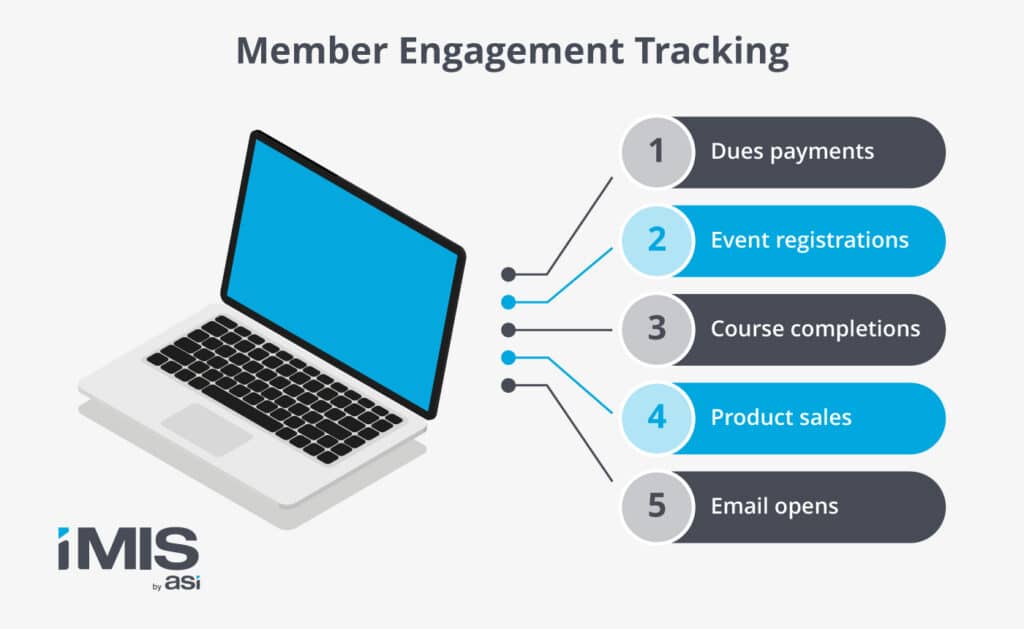
Flagging at-risk members: iMIS’s union management software guide explains that AI can assign engagement scores to predict whether someone is highly engaged or at risk of lapsing. Common examples of engagement criteria you can set include on-time dues payments, event registrations, course completions, product purchases, and email opens.
- Suggesting the next-best action: AI can suggest the next-best action for personalized engagement steps that feed your member engagement flywheel, such as a targeted nudge to renew dues or an event invitation tailored to an individual whose score is dropping.
- Enhancing data monitoring: Integrating these agents with tools like Datascout eliminates the need for complex manual queries and spreadsheets. Datascout turns raw information into clear insights by aggregating behavioral changes, such as training completions or drops in activity, and translating those patterns into visual timelines and precise outreach recommendations.
Set up automated alerts to notify your retention specialists the moment an agent identifies a high-value supporter whose engagement score dips into the danger zone. Proactive intervention guided by predictive analytics is far more effective than trying to win back a member after they have already left.
Conclusion: Next steps for smarter operations
Adopting new technology shifts your team’s focus from administration to relationship-building and grassroots engagement. AI removes daily friction from the member journey, empowering your team to focus on improving benefits and connecting with at-risk members.
As you modernize your workflows, be smart with your implementation strategy. Establish clear AI policies and governance guidelines when automating constituent touchpoints, so your members can rest easy knowing you’re using their data ethically. Explore the AI features already available in your existing platforms or seek specialized member management software that offers tools designed to streamline the entire lifecycle.
To start weaving AI into the member journey, pilot your automation efforts with a single workflow, like onboarding, to establish a proven blueprint before scaling across your organization.