
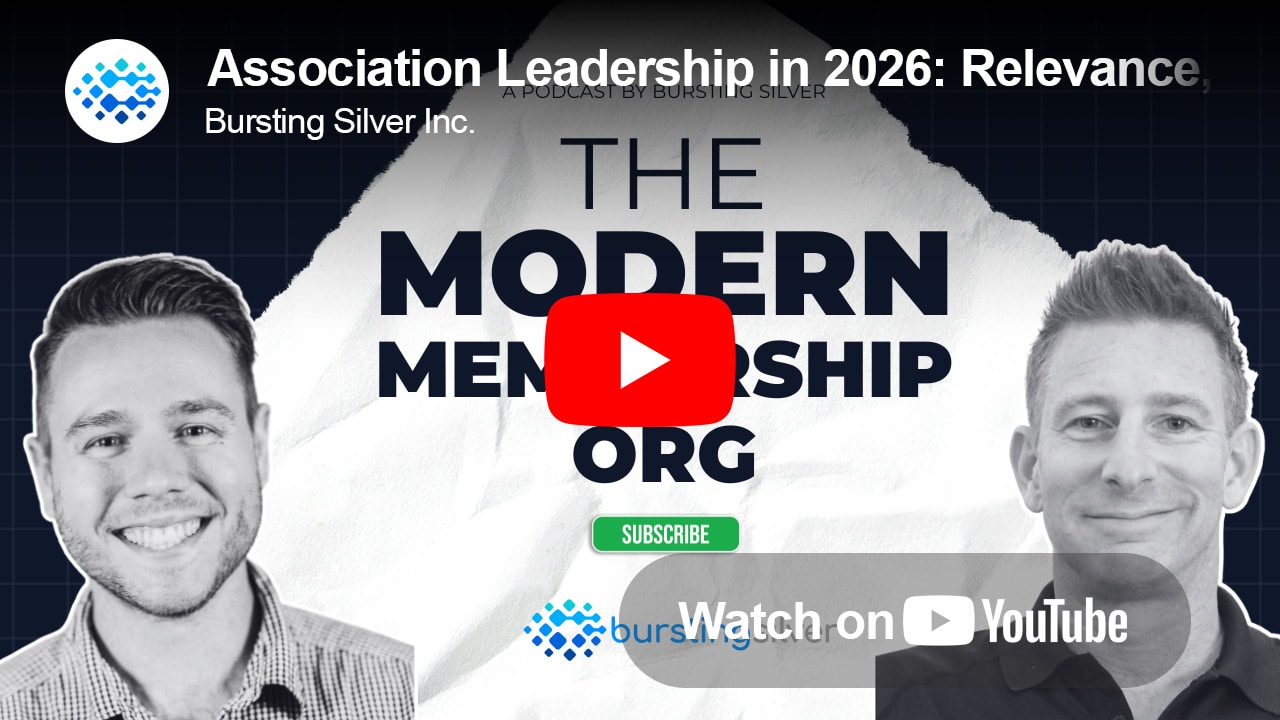
Episode summary
Most association leaders already know the word. Relevance. They know they need to earn it, that the old default position “of course you join the association” is gone. The question isn’t whether to change. It’s whether they can actually execute on it.
In this episode, Riley Miller sits down with Al Povoledo, CEO and founder of Bursting Silver, to dig into what association leadership really looks like in 2026. Al brings 30+ years of working with hundreds of associations on strategy, operations, and technology, and he doesn’t sugarcoat the pressures. Dues growth is slow. Member expectations have been reset by Amazon and Netflix. Internal teams are stretched. And technology, the thing everyone wants to be the answer, doesn’t fix a broken foundation. It exposes one.
The conversation moves from the pressures association leaders are feeling right now, through the places where technology bets go wrong, to a practical four-step playbook for adopting technology in a way that actually delivers results. Al’s closing advice after three decades in the field: don’t start with the technology.
In this episode
- Why “relevance” has replaced “growth” as the top concern for association leaders — and what it actually means to earn it
- How Amazon and Netflix permanently raised the bar for member experience, and why associations are feeling it
- The real reason technology investments fail: not the tools, but the foundation underneath them
- A four-step playbook for technology adoption that builds credibility and manages change at the same time
- Where Al sees association modernization heading over the next two to three years — ecosystem models, lifecycle thinking, and data as a strategic asset






The Modern Membership Org Podcast
Full Transcript
Al (00:00)
And I think that’s where a lot of organizations get stuck. They jump to solutions.
before they define the actual problem. So at the end of the day, it’s not about having the best tool. It’s basically about staying focused and delivering value to your members, right? If you have that clarity, it will drive everything and the technology is just gonna enable it once you get to that point.
Riley Miller (00:30)
welcome to the Modern Membership org. My name is Riley and I am joined today by CEO and founder of Bursting Silver, Al Povoledo. Bursting Silver is a North American consultant agency here focused on helping membership-based organizations navigate business and technology transformation.
With over 30 years of experience, Al has worked closely with hundreds of associations on strategy, operational improvement, and technology modernization. Welcome to the show Al
Al (00:55)
Thanks, Riley. Good to be here. It’s my first podcast, so I’m excited.
Riley Miller (00:59)
Yeah, excited to have you on too. I know we’ve we chat back and forth, especially with this podcast taking off and really excited to have you on here to share your expertise and insight from a leadership perspective. So, yeah, absolutely. I think coming in strong now as a CEO, then from from your perspective, what do you think association leaders are worried about right now in 2026 here?
Al (01:12)
Awesome, let’s do it.
Sure, you know, at the highest level from talking to a lot of my peers and colleagues, I think most association leaders are focused on relevance. I think that’s the big word that’s bouncing around in people’s heads. They’re asking questions like, how is my association still essential and relevant to our membership? And secondarily to that, you know, how can we adapt fast enough to meet those
changing member expectations and expectations around being relevant.
Riley Miller (01:53)
Yeah, so in terms of this relevance online attention competition, why has relevance then become such a big pressure point for associations?
Al (02:04)
Yeah, it’s actually not just online, it’s just in general. And it comes down to the fact that the default position that associations once had is gone. There was a time when if you were in a profession, let’s say you were a realtor or a CPA, you would join the association. That was just part of the path, right? That’s not necessarily true.
Right today members have options. They can get education, community credentialing from a range of sources, right? And often it’s faster. It can be more tailored. Sometimes it’s cheaper. Sometimes it’s free, right? So associations don’t have this default position anymore. They have to actually earn it with their members. So that’s a big challenge. Now relevance, that’s the big one. In addition to all that, right? There’s member expectations that are changing.
And those are big factors at play here too. First, member expectations are changing in terms of how they’re looking at associations and what they’re offering. Members don’t necessarily just want to buy activities like a conference or an education session, right? They want outcomes, they want career advancement, they want expanded networks, they want best practices from you, right? They don’t want that transactional relationship from you.
And second, member expectations are changing in terms of their expectations on how you deliver those products and services. So they’re interacting with Amazon, Netflix, the banks. These are big mega-corps that have tons and tons of money and they’re offering these brilliant online experiences to their members. And we buy something on Amazon, it shows up the day after, now we expect that exact thing from our association. So.
that’s a big challenge that associations are facing as well, member expectations. So when you add up relevancy, when you add up changing member expectations and they’re the higher bar that they expect you to operate at, a lot of this is just fundamentally changing the equation on how associations exist, right? So staying relevant isn’t automatic anymore. You have to deliver continuous value and that’s what’s driving a lot of the pressure right now.
Riley Miller (04:08)
Yeah, I love that Amazon reference because I know I’m guilty. I project that onto everywhere I do business or everything I work with as well. mean, drilling into that further and taking into consideration now all of those factors at play, what’s making it then so hard for associations to stay relevant?
Al (04:13)
Yeah.
Yeah. Well, first of all, I think it’s important to acknowledge that association leaders generally know that they need to stay relevant. Like this isn’t big news to them necessarily. They know about the concept of continuous engagement.
personalizing communications, providing positive outcomes for members. that’s the bread and butter of why associations exist. So I don’t wanna sit here and say that they don’t know this, but the real issue to me is execution. They’re having trouble executing on staying relevant. And there’s a couple of factors at play, I think in general here. to list them out, money and people.
So the first one is around money. Look, every association is facing revenue pressures right now. Dues aren’t growing as fast as they once did. And there’s a lot of sensitivity at the economic, at the macroeconomic level. Members don’t like it when their dues go up. And so there’s pressures there and there’s competitive pressures as well, right? The stuff I mentioned a couple of minutes ago. So that’s the first factor, money. And the second is just around people and process, right? Internally,
associations are operating with small teams and generally legacy skill sets. So the capacity is tight to actually really make a change and to execute. It’s really hard to execute when you have those kind of challenges. You know, I can give you an example of a recent project that’s the perfect example of what happened there.
It was an organization we working with that really wanted to make a change. They wanted to introduce a more personalized member journey. So they wanted to take every one of their membership types and map out their member journey from cradle to grave. Everyone agreed that that was the right move. It’s a no-brainer. It’s what you do and makes total sense. But what we found is when we got into it, it got a little complicated pretty quickly.
We found things like, their systems couldn’t just support it. There had to be change there. The data that they had about their members wasn’t reliable. There was even internal friction on the direction they should take, right? So something that looked really straightforward, member journey, map it out, optimize it, execute, it actually became very difficult operationally. So at the end of the day, it became about execution or lack thereof.
So I’ll say that this is an example, but the story ended well and it was successful project. So we had these very honest conversations with the client about what needed to change. But these are very common things that we run into. Okay.
Riley Miller (06:58)
Yeah, totally. I mean, there are plenty of challenges and you’ve definitely labeled a large set of common
ones. And now in identifying all these areas where association leaders, even if they are aware of them, are focused on how can we then address these challenges and where does technology fit or assist in that process?
Al (07:19)
Yeah, well, technologies is always part of that convo, right? I think here the issue is that technology is often positioned as the silver bullet of this conversation, right? And to be fair, we have some pretty incredible tools. We’re at the forefront of AI and there hasn’t been a more interesting time to be.
investing in technology to support your membership, that good stuff. But hey, I’ll say something that’s going to surprise you. Technology doesn’t always solve the problem. It doesn’t fix a broken foundation. It actually exposes it. So people have to understand that. And that’s where organizations get stuck. They expect technology to do too much on its own.
If I had a nickel for every time I talk to a client that wants to throw away a technology because it’s just not working for us. And then when you take a real hard look at it, it doesn’t come down to where the technology worked or not. It’s just they didn’t have it integrated with their people and processes. So there’s kind of throwing the baby out with the bathwater. But, you know, that’s fundamentally the problem is just thinking that tech is a silver bullet. I’ll give you another example. OK, we worked with another organization.
and ⁓ they wanted to better understand which members were actually driving engagement and value. And so the decision was made to leverage one of ⁓ our AI tool solutions to basically dynamically interact with members on a very personalized basis through emails and chats, etc. It very, very tailored, very specialized. The AI felt like you’re talking to someone real and it was very
relevant to that member situation, et cetera. Absolutely incredible, cutting edge stuff. In theory, an absolute no brainer to do, a great solid idea. But the insights about these members and all that were really buried across different systems, processes, data points, events, committees, right? All that stuff needed to be connected in a meaningful way.
So we found that that, you just can’t drop an AI tool and everything’s going to change or a tech tool. It’s going to change, you know, so once they realized that everything changed, they said, we need to clean up our data. We need to change some of our processes, et cetera. And when we did that, then they could, they started using the tool and they could see patterns and prioritize outreach and make decisions and all that good stuff. So there was challenges, but the key point here, what I’m trying to get at is, you know, association shouldn’t just adopt technology because it’s, you know, cool.
or the perceived right thing to do, because a board member said, hey, you need to put in technology or put in some AI solution. You should really look at it as an opportunity and adopt it so you can operate differently and better. And the organizations that understand this over the next two, three years, I think are really going to pull ahead of the market and overcome some of the challenges that we talked about.
Riley Miller (10:04)
Big time. I’d like to call out, because AI is obviously that huge topic today, and it’s continuing to push boundaries and be a disruptor. You even mentioned too when it came out, there’s no silver bullet, but it’s very exciting time to invest in your membership because you’re trying to increase that experience, and you have board members sitting around the table telling you the new tool or the new toy that they saw online or read on Tech Insider.
Al (10:07)
Yeah. Yeah.
Riley Miller (10:31)
they should be using. So now,
back to the leadership side, how should leaders be looking at this new technology and all of its capabilities? Yeah.
Al (10:33)
You mean AI?
Yeah, well, that’s where it gets interesting, right? AI is a real opportunity, right? But at the same time, there’s a lot of noise out there, right? And I think for board members, association leaders, the key to approach it is a little bit of curiosity and open-mindedness, but at the same time with a little bit of discipline and some focus, right?
I’d say generally associations are more in the early stages of AI adoption. They’re experimenting, they’re trying to understand where it fits into their world. I think they’re more focused on internal efficiencies, things like reducing manual effort, sharing information, using tools like GPT and Gemini, et cetera. Very basic starting points, but very meaningful at the same time. The challenges start when organizations expect AI to be
know, transformational out of the gate. That’s where the expectations get way ahead of the actual reality of it, right? So to answer your question, how should leaders think about AI? Don’t look at AI as a strategy. It’s just a capability, okay? And a very cool and capable one. But it has to be looked at in a way where it delivers
the most value when it’s applied to a very specific high impact problems. So the organizations that I think are going to get the most traction are the ones applying it to specific problems, learning from that and then building from there, right? It’s not about chasing the big, you know, the latest shiny object or the latest and greatest tools is really just about.
Hey, where can AI genuinely improve how my organization, my association operates and provide value to my members? That’s what it really comes down to. So the associations that can actually think about it this way and think thoughtfully about how to approach AI in the next couple of years are really going to separate themselves from the others because the others will be either doing nothing or they will probably be doing way too much and they won’t get as much out of it as they expected.
So apply AI to the right places.
Riley Miller (12:43)
Yeah, big time. now, mean, considering
that and the wide breadth ⁓ of where that could go between doing too much or not under utilizing it for what it’s worth, I’m an association executive. I’m putting on my executive hat. I’ve come to speak to you for your guidance on what you know. What would you recommend as a playbook for technology adoption to help my association differentiate? Like that could be on an AI front or even just
tech available in general that might be overlooked nowadays.
Al (13:14)
Yeah, fair enough. I think to get a return on a tech investment and AI investment, there’s some common steps that you have to take. The first most fundamental one is anchor everything you’re going to do.
to a real business problem, right? It goes back to the, don’t buy a shiny object. Don’t start with saying, you know, we need AI or we need a new system. Start with the problem statement. Where are we inefficient? Where are members frustrated? Where are processes too slow? Right, start with that business problem, right? And then once you, once you figured that out, focus on your workflows, how things work, your operations, how you interact with your members.
Don’t focus necessarily on the features and functions. I’ve seen a lot of clients make big technology investments because they’ve seen, you know, sexy features and functionality. And then they, you know, they buy the solution and then they go, well, that was cool. And I saw it in the demo, but not really using it. Right. So think about how that technology is actually going to be applied in your process and how you operate. Right. Third, I’d say
I know I’m going through a big list here. take notes people. Invest in the readiness of your organization before you roll it Make sure you’ve got clean data. Make sure the ownership is clear in terms of who owns the processes and systems and how it’s rolled out. Make sure you have policies in place. Make sure your people are on board. Because without that foundation,
Technology just adds noise to the system. Like, and I referenced this earlier, you know, I’ve seen clients put in technology and just not be just for the sake of technology, but they weren’t really ready for it. Right. And I think the last step is when you do that, right, just do it for a small piece of your business. Okay. Start small and scale out. We’re don’t don’t try and transform, transform the whole organization. One big move, one big bang.
Right. Pick some use cases, pick some targeted issues, prove value and then expand out. That’ll build momentum, that’ll build credibility and you’ll be ready for the next one. And it also manages the change within your organization, right? You want to just, I want to throw so much out there that it just completely shocks your staff and members slowly but surely. Yeah.
Riley Miller (15:29)
Yeah, this slow release is key, I think.
Well, given everything we talked about then, I think it’s important to look at these things holistically and where we’re going in the future. Where do you see, from a trend point, ⁓ association leaders leaning towards or moving towards for their overall organization modernization moves?
Al (15:52)
Yeah, a few trends are I think are happening. I think orgs are moving away from closed end systems to more to the ecosystem model, right? So instead of
relying on one heavily customized platform, right? They’re looking to best of breed solutions that ⁓ integrate with over time. And I’m not suggesting that one vendor can’t bring the whole solution because there’s a lot of vendors that are buying different point solutions up and integrating, which makes a lot of sense. But I think in the past, lot of orgs have bought,
big, big solutions that have done some things really well and some things really poorly. that, that’s, if you, if you look at the landscape right now, there’s some vendors out there that are just doing some very good specific things. And if you can, you know, buy those solutions and integrate them, you’d be ahead of the game. I think another big trend is just this shift from, you know, the transactional thinking of, you know, dealing with your members, or interacting with your members to, you know,
life cycle thinking. It’s not just about the join anymore, about the renewal, right? It’s about how you continuously deliver value to your members and personalizing those journeys with your member. Third one, huge data. Data is a strategic big time asset now. I think in the last 20 years, the association has been collecting data.
a lot of it, but have they been managing it and using it to drive decisions? They’re starting to, but now with AI and these tools that are available to you, it’s absolutely incredible real time, amazing analytical information and analysis you can get out of it. So data is a big one. And I think finally, technology is no longer a topic that your IT guy or gal talk about and need to convince the board about.
It’s a leadership issue, right? CEOs and boards are getting much more involved because it’s directly tied to outcomes more than it has ever been. And people are just getting generally smarter about this. The topic of technology and AI is more approachable and it’s obviously a big factor at the executive level. So I think those are the big factors there.
Riley Miller (17:59)
Yeah, I mean, we have an incredible list that we’ve been going through and I would hate for you to take all of this key insight and summarize it. for today’s talk here, if you had to, like your listener here, your association leader, anybody have listened to this podcast to the end and you want them to take away like one special key gem, what would you leave our listeners here with?
Al (18:24)
Okay, yeah, well, I’ll shock you as a 30 year technology guy, I’m going to say, out right, don’t start with the technology. All right, start.
with being really clear about the business objective you want to achieve. Be really clear on the value you’re trying to deliver to your members. And because that if that’s where you’re falling short today, technology is not going to solve that problem. Once you have that clarity, the path will become a lot more obvious. You’ll be able to align your data, align your process, change your processes, select your technologies around something that actually matters.
And I think that’s where a lot of organizations get stuck. They jump to solutions.
before they define the actual problem. So at the end of the day, it’s not about having the best tool. It’s basically about staying focused and delivering value to your members, right? If you have that clarity, it will drive everything and the technology is just gonna enable it once you get to that
Thank you.
Riley Miller (19:15)
words.
Well, Al, thank you so much. Really appreciate your time and appreciate the value that you’re bringing to the podcast
here. Yeah, we’ll have to get you on again sometime. I know that you’re full of insights, not just for associations, but beyond. So I’m sure there will be future conversations we’ll have you here for.
Al (19:34)
Yeah, there’s a lot of interesting topics out there. And I mean, we could have just taken any one of your questions today and probably done, you know, another 25, 30 minutes just talking about, you know, those topics themselves. So lots to talk about. I would love to come back.
Riley Miller (19:48)
looking forward to it. Thanks so much, y’all.
Al (19:50)
Thanks, Riley.
Riley Miller (19:51)
All right, that wraps up our episode for the Modern Membership Board podcast. Please consider subscribing if you don’t subscribe already and we will catch you on the next episode.
Modernize Your Organization With Confidence
You deserve a modern platform that supports your mission without increasing complexity.