
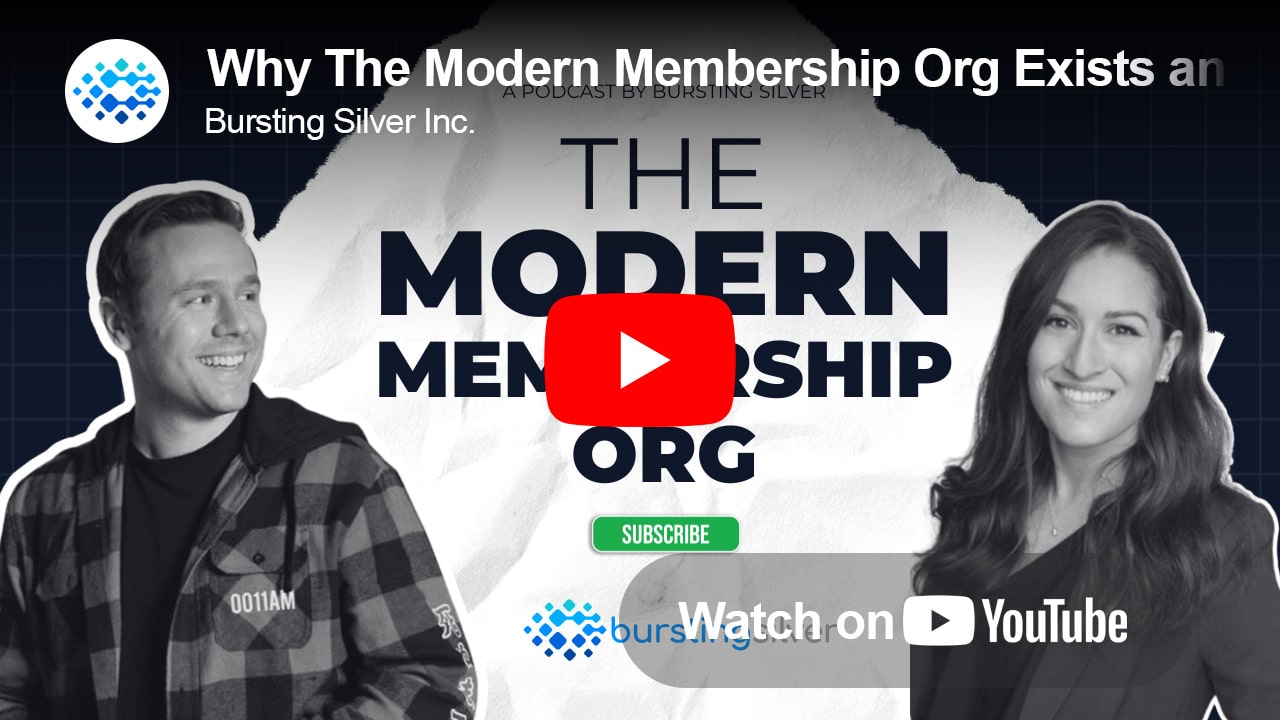
Episode summary
“We’ve been on the system for years, are we actually getting the most out of it?” It’s the question Riley Miller and Tanya Mirrlees hear from executive directors and operations leads all the time. The honest answer is usually no, not fully, and there’s a quiet gap between what the platform can do and what the organization is actually using it for. Closing that gap is the whole reason this show exists.
In this pilot episode of The Modern Membership Org, Riley and Tanya introduce themselves, lay out who the show is built for, executive directors, directors of membership, registrars, operations leads inside associations, regulatory bodies, and unions, and walk through the realities of where membership-technology actually stands in 2026. They talk through the workarounds staff have quietly built up over the years, the AI conversations every leader is suddenly being asked about, and what it really looks like when technology meets staff halfway instead of getting in their way.
If you’ve ever felt like your AMS, your processes, and your team are slowly drifting apart from each other, this show was built for you.
In this episode
- The “are we getting the most out of our system?” gap, and why it grows quietly over time
- Why every association, regulatory body, and union is being asked about AI right now, and what a useful answer actually sounds like
- How staff workarounds (spreadsheets, manual processes, custom workflows) start as fixes and end as liabilities
- What “modernization” actually looks like when it’s done well, process first, software second
- Where Bursting Silver fits: full implementations, targeted modernization, and purpose-built tools like the iMind Assistant
- AI governance, the part everyone skips, and why it’s the gateway to using AI safely
- What’s coming on the show, guest interviews, partner conversations, panels, and real stories from leaders who’ve been through modernization






The Modern Membership Org Podcast
Full Transcript
Riley Miller (00:00)
All right, so here’s the question we hear from executive directors and operation leads all the time. We’ve been on the system for years and are we actually getting the most out of it? Now, honestly, the answer to that question is more often than not, no, but not fully. There’s really a gap between what the platform can do and what the organization is actually using it for. And that gap tends to grow quietly over time. Staff work around it, processes drift, technical debt accumulates.
Everybody’s necessarily doing the same thing. Nothing’s wrong. It just happens naturally. And that’s what this show is here to address. It’s about closing that gap, making the technology actually work for the organizations it’s supposed to serve. Welcome to the Modern Membership Org podcast.
I’m Riley. I’m part of the client success team here at Versing Silver, and I’m joined by my colleague, Tanya Mirlis.
Tanya Mirrlees (00:56)
Hey everyone, we’re really glad to be here. We’ve talked about doing something like this for a really long time and we’re just super happy to be recording it.
Riley Miller (01:02)
Yeah, this is episode one of the Modern Org podcast and ⁓ today is the foundational piece where we’ll introduce ourselves, we’ll explain what we do, who we do it for, give you a sense of ⁓ who this show is aiming to speak to and what we’re looking to cover. So today we’re gonna talk about what’s happening in membership organization technology space today and ⁓ there’s a lot to talk about. hence why we have a podcast that we’re gonna be reviewing different topics each week.
Tanya Mirrlees (01:30)
Yeah, and if anything we say today sounds like your organization, make sure to stick around. There’s lots of episodes coming, including guests who we’ve actually been through, but you might be navigating right now.
So for the people who haven’t come across bursting silver before, maybe let’s start with who we are. Riley, did you want to go first?
Riley Miller (01:45)
Yeah, so as I mentioned, I’m on the client success team here at Bursing Silver. I’m a senior consultant. I’ve been with the team for six years, working with membership organizations across North America to help improve their systems. What I find the most interesting about the work that we do is it’s never really just about the software. It’s about getting to know the organizations, how they actually run, and finding opportunities where they can improve their process flows and their workspaces. The technology is there, but ⁓ really where the magic happens is
where the technology can meet the staff halfway.
Tanya Mirrlees (02:15)
Yeah, and for me, my background’s a little bit different. I just joined bursting silver’s client success team earlier this year. And before that I was working in insurance supporting a sales team. In that role, I saw very much how the day-to-day operations impact everything from team morale to client experience and even employee retention. When processes aren’t working well, people really feel it. And on the flip side, when organizations are using systems properly and building strong workflows,
It just creates clarity, reduces friction, and people are just happier doing their jobs. So coming into this space, that’s what really stood out to me. The organizations that get the most out of their systems are treating it as an operational tool and not just a database. You have to be intentional about it supports your team day to day.
Riley Miller (02:59)
Yeah, that’s really good way to put it and I think that’s why there’s a gap for a show like this. There’s plenty of tech podcasts out there for association management or for union operations, but a lot of that content, it sits at the intersection of how those unions are serving, but not how their technology is serving them. So that’s where this podcast is going to jump in specifically to call out.
⁓ quick wins that have helped improve organization process flows, improve staff morale, improve staff functionality, improve budget on technology spend, all of those things we’re looking to cover in case studies and bringing in partners to talk about their wins and also their pitfalls without being overly focused on features. And we mostly want to tell stories.
Tanya Mirrlees (03:49)
Exactly, and we could do that because that’s the space that we live in every single day.
Riley Miller (03:53)
Yeah, so let’s talk about where we actually stand in membership technology right now because there’s a few things worth naming directly. For example, first, lot of organizations run on infrastructure that hasn’t fundamentally changed in a decade or more, which is fine, but there are pain points that staff and administration or even the board members are experiencing every day. They’re hearing it from members, they’re hearing it from staff.
their budgets being pushed because there’s processes that just aren’t serving their needs correctly. So the software may have been updated, but the way the organization is using it, the processes, the data structure, the workflows, those often haven’t kept up. Over time, this creates real friction.
Tanya Mirrlees (04:35)
Yeah, and that’s the frustrating thing. It’s usually invisible until it is in. Staff just end up adapting and they build workarounds. They use spreadsheets to do things that iMIS could handle or other systems and they process things manually that could be automated and it works until it doesn’t and then suddenly you’ve got a real problem on your hands. Yeah, and then you’re working back through workflows to try to make things more efficient. Yeah, it’s challenging.
Riley Miller (05:00)
Totally. I see that far too often. I think that’s where we really shine in terms of helping walk through processes with different associations and reviewing those pain points and putting them in an actionable plan to alleviate those stresses, get them into new workflows that actually start working for them. And so in practice for associations, this often shows up in engagement data that they can’t trust anymore. Renewal workflows that cause more
and for new workflows that need some manual workarounds because their system just hasn’t kept up or reporting that takes way too long than it should, essentially clicking run and then watching the hourglass flip around on your screen for too long. That is not only just painful for staff that have to do it all the time, but that’s now time that could be spent doing other things that if we’re able to streamline those flows, staff are able to actually reach out to members, have those like personal engagement points.
Members are going to provide positive feedback on renewal flows now that they can just jump in and pay their dues and get out super easy. then reporting to getting that information to that board level faster where you’re able to make actionable decisions based on the reports you’re running is huge.
Tanya Mirrlees (06:11)
yeah, yeah, it is. for regulatory bodies, tends to show up in the registrant life cycle applications, renewals or status changes. And it’s often held together by a mix of software, emails and spreadsheets. And there’s a real risk in that because these organizations are accountable to the public and to the government and process in inconsistencies isn’t just inefficient, it’s a liability. For unions, it might be dues tracking, grievance case management.
and organizing data that lives in multiple places and nobody fully trusts any of it. And things can get missed because you don’t have a consistent workflow. So yeah.
Riley Miller (06:46)
Yeah, I mean all that and then enter in the AI conversation adds a whole nother complicated layer because now every organization is coming with an expectation from the members but also from the staff. Is your organization using AI? Are you ready to start thinking about AI? The honest answer for most organizations is they’re thinking about it, they’ve heard about it, the buzz is there but like finding out where to start or
⁓ understanding the risks that are involved with different tools. It’s just that is now a gap worth addressing. A lot of these organizations have a big responsibility to their memberships and with a lot of these tools it’s just moving so fast. How do you know which is the right one, which one’s safe, and what’s actually going to help your organization instead of just creating more work?
Tanya Mirrlees (07:32)
Yeah, and it’s completely reasonable to be a little bit worried about AI. The hype around it is enormous. ⁓ But most of the conversations are aimed at big enterprise technology teams and not an operational’s director or professional associations or registrar at a regulatory body who just wants to know, is this useful for us and is it safe? Those are the conversations that this show is built for.
We’re going to be honing in on the opportunities where AI can support that staff of 20 who are serving 10,000 members or registrants and they just need to make good decisions with limited time and limited resources.
Riley Miller (08:09)
Exactly. The right technology used well is actually well positioned for a lot of this. If you know how to use it, that’s the big if, which is kind of the whole point here. So the Modern Membership Org here, why a podcast and why now?
Tanya Mirrlees (08:22)
Yeah, and I think the honest answer is that we just kept having these types of conversations with our clients, with our colleagues, and especially at conferences. There wasn’t really a place for those conversations to be happening publicly and in a way that is actually useful to the people who need them.
Riley Miller (08:38)
Yeah, there’s no shortage of technology out there. The content we’re getting inundated with every day in our LinkedIn feeds or our Instagram posts, it is either vendor driven as a sales pitch or it’s a new webinar targeting IT professionals in large enterprise environments. The decision makers we work with every day, executive directors, director of membership, registrars, they’re not always looking for that deep technical content. They want to understand what
a technology decision actually means for them and their organization, their staff, their budget, their members.
Tanya Mirrlees (09:13)
Yeah, and I think they want to hear from people who have actually done it. They don’t just want to hear theoretical examples. They want stories from real organizations, real challenges, and they want to know the real outcomes. Some episodes here will be just the two of us, just like this one, working through a topic together. And others will be having guest interviews, leaders from organizations, regulatory bodies, unions. And then I’ll be talking about
what they’ve been through. We’ll have some conversations with partners in the iMIS ecosystem and we’ll do panels when a topic has enough angles that sometimes just two voices aren’t enough.
Riley Miller (09:49)
Yeah, I think the consistent thread here is going to be what does this actually look like in practice? If we’re talking about AI, we want to be specific here for membership organizations, talk about how that’s improved their systems. If we’re talking about system upgrades, we want to talk about what that business case looks like, not just the technical checklist, but in that as a case study, what were the problems we were addressing? What were our approaches? What were the unknowns? And then what were the wins?
Tanya Mirrlees (10:17)
Yeah, and we’re going to be honest, this work is not always smooth. Implementations are complicated. Change management is really hard and organizations have real constraints. We’re not going to pretend that it’s otherwise.
Riley Miller (10:30)
Yeah, no, we’re not going to sugarcoat it. It’s not always a win. It’s not always a overwhelming success. I think that’s part of the learnings. And that’s also the unique part that we’re in a position to get to know these organizations, understand how their process flows go, hear their pain points, but also address the ones that they don’t necessarily see. They’re too close to it every day. I think that’s where this will also shine. It is highlighting those similar cases and being able to listen to that, take that back to your own organization for
a nice overview of how your team’s working. So maybe we should say a little bit more about bursting silver here, because we have talked a bit about what we do. And since this is the first episode, maybe some of you may not be familiar with where we work.
Tanya Mirrlees (11:12)
Yeah, yeah. So let me give it a little plug here. Bursing Silver is an authorized iMIS solution provider and a leader in the AI space for nonprofits. We work exclusively with membership organizations, associations, unions, and regulatory bodies all across North America. We empower teams to serve their missions more effectively.
Riley Miller (11:31)
Yeah, and so what we actually do ranges quite a bit. And sometimes we’re brought in for a full implementation, an organization is moving to a new platform for the first time, say they’re ⁓ going to iMIS or migrating from a legacy system. Sometimes it’s a modernization project where we’re going to be reviewing what they’re doing and how they could do it better, or what they’re using and what new tools actually serve them more effectively when just the configuration hasn’t kept up on how the organization has grown. It happens far too often.
Sometimes it’s more targeted. A specific process is broken, a reporting problem, a renewal workflow. We have a nice suite of tools that are also built for iMIS and outside in your other CRM platforms that address just that. So we’re not necessarily a shop that comes in and does a full overhaul. Sometimes it’s as simple as here’s a new tool that we’ve built that we can help walk you through or you can adapt into your processes.
Tanya Mirrlees (12:26)
That’s a really good point, Riley. So just to build on that, those tools that we have built, they include case management tools, document management solutions, and AI integrations. And these tools come out of real client problems. A good example is the iMind Assistant that we built for the iMIS user groups. We didn’t just build this because AI was a hot topic, but we built it because the members had a clear, practical need for faster answers about the platform.
And so that’s the thing, like we start with the problem, we’re honest about the right solution, and we make sure that it actually works for the people who are going to be using it.
Riley Miller (13:00)
Yeah, and adds value to the membership too. Specifically for that iMind tool, I use it. I know I need to jump in there because I can ask it simple questions and it gives me well thought out answers for the tool that I’m using. So I’ve heard countless stories from other individuals that are part of the iMess user group at different conferences and meetups that they say that they use that tool daily when it comes to helping them flush out IQAs or understanding business objects.
just when you can’t find that information from the help documentation, that little question can really ramp up how your flows go. We’ll link to a lot of these case studies too in our show
that’s probably the clearest way to get a sense of the range of the work that we do. There’s plenty of examples on our website, burstingsilver.com slash case studies, where you can find that. I think some of the most glaring case studies are like major wins that we’ve had, for example, working with the Unite here they have a lot of huge needs that we’re able to pull off.
specifically during COVID. So I highly encourage you to check that one out. That was a massive undertaking with a major success there.
Tanya Mirrlees (14:05)
Yeah, and like Riley said, you can either check them out on our website or we will link them in our show notes. And if something sounds like your situation, reach out. We are always happy to talk.
Riley Miller (14:15)
Yeah, so about talking, what’s coming up next? What conversations are you most looking forward to hearing? Or talking about, I guess you’re gonna be on this podcast.
Tanya Mirrlees (14:17)
That’s it.
Yeah, honestly, I am most excited about the AI episodes. Not just the idea of AI, but like how it’s used day to day. And I was thinking when you mentioned that you use the iMind tool, sometimes there’s a bit of a taboo around admitting that you use AI, but I think it will be cool to learn how AI can be used to increase our workflow or sorry, increase our efficiencies and assist in workflows.
especially in the regulatory body space because they have compliance obligations to the public and they have trust to protect. I want to know what does it look like to union staff when they’re asked about AI tools and nobody’s really sure which ones are safe. I just get a feeling that, or I just know that these conversations are happening in every organization right now. So I’m excited to chat about it here and hopefully give some confidence to people in this space.
Riley Miller (15:13)
Yeah, I think it’s interesting the taboo that comes with using AI. For an artist, I’m sure that is frowned upon. in our spaces, we’re looking for ways to work smarter, not harder. And it’s a tool at our disposal in this day and age that is constantly growing. But there’s a lot of amazing conversations happening around how that tool is being leveraged and how that’s enabling workflows more effectively. I think it’s snowballing on that not to…
Tanya Mirrlees (15:17)
Yeah.
Riley Miller (15:40)
really drive home your point too, but I’m looking forward to talking about AI governance. I think that AI governance is often overlooked from organizations. We see all these exciting tools that we really want to dive into, but we’re forgetting to cart for the horse situation here where we’re not setting out the guidelines or expectations on how our organization is going to use AI. What is our expectation to staff? What are the guardrails for using this
tool in our workflows to better serve our members? Are we considering what risks there are in also informing our members where we’re using AI safely to ensure that there’s still trust in their data and confidence that we’ve thought out ⁓ how we’re making sure that this is being adopted safely. So I think that is the gateway into responsible AI that ⁓ will help us, I guess, effectively.
use this tool, use this resource, enable our staff safely.
Tanya Mirrlees (16:37)
Yeah, totally. And on top of that, we’ll have guest episodes, we’ll have leaders from member organizations, and they’ll be talking about their decision to modernize and what it looked like from the inside. We’ll get a perspective from our listeners too. So we’ll want to know what surprised them and what they would do differently. Those conversations are going to be the most valuable because there’s absolutely no substitute for someone who’s actually been through it.
Riley Miller (17:02)
Yeah, I think there is an opportunity here to bring in some real boots on the ground experience. That’s part of a podcast, I think, being able to bring on guests and give their story in a nice conversation piece. That highlights the everyday system or everyday situation that we’re working in. So it’s gonna be nice to bring in some guests, some partners as well, where we have a lot of really cool tools on the horizon and we can…
talk about what inspired those tools and what those tools are aiming to serve and where they’re going. I think that’ll be huge.
Tanya Mirrlees (17:36)
Yeah, honestly, yeah, I’m really excited for what we’re going to be putting together here. hopefully that everybody ⁓ subscribes where they listen to wherever they listen to podcasts, we’re going to be putting out new episodes every week. ⁓ And from here on out, we’re only going to be getting more specific.
Riley Miller (17:50)
Yeah, I think this one is just a nice general introduction, but be sure to check us out. We’re going to be on YouTube and Spotify. Give us a rating. We really want to get this off the ground. And we’ll catch you on the next episode next week.
Tanya Mirrlees (18:03)
Yeah, we’ll
Modernize Your Organization With Confidence
You deserve a modern platform that supports your mission without increasing complexity.